

If you’ve been involved in affiliate marketing, you’ve probably come across ad networks. But if you’re new to the concept, keep reading. This article will explain what ad networks are, why they’re essential for promoting your services, and how the best ad networks for advertisers can help maximize your results.
Ad Networks for Advertisers connect businesses with publishers, enabling targeted advertising campaigns that drive qualified traffic, improve conversions, and maximize advertising ROI. The best ad networks for advertisers in 2026 and 2027 are span social giants (TikTok Ads, Snapchat Ads, X Business, Microsoft Ads), self-serve performance networks (ClickAdu, ClickAdilla, TrafficStars, Galaksion, TwinRed), and specialized platforms (Primis for video, SXM Media for podcasts, Amazon Ads for retail).
This guide has been checked against each network’s own advertiser documentation, help center, or billing policy page, so the deposit and budget figures below reflect what’s currently published.
What is an Ad Network?
An ad network for advertisers is a platform that aggregates ad inventory from many publishers and lets marketers buy targeted placements by geography, device, interest, or audience segment through a single self-serve dashboard, typically billed on a CPC, CPM, or CPA basis.
Google Ads and Meta (Facebook) Ads dominate headlines, and together they’ve historically accounted for roughly a third of global digital ad revenue. But dozens of other networks exist, each offering distinct traffic sources, verticals, and pricing models many of which are especially valuable to affiliates driving performance-based traffic rather than brand awareness.
Why Do You Need an Ad Network?
Ad networks act as intermediaries between advertisers and publishers, filling unsold ad inventory and distributing it to relevant advertisers automatically. Using technology like real-time bidding (RTB), networks can target consumers based on location, interests, browsing habits, and more giving advertisers better precision and efficiency than manually negotiating placements site by site.
For publishers, the same infrastructure provides tools to track performance, maximize ad revenue, and monetize inventory that would otherwise go unsold a topic covered in more depth in our CPM ad networks guide if you want to understand both sides of the transaction.
How Do You Choose the Right Ad Network?
Selecting the right ad network for your campaigns can be challenging, since the number of available platforms has grown exponentially. Weigh these factors before committing budget to any single network:
- Marketing strategy alignment: Does the network’s traffic and format mix actually align with your advertising goals brand awareness, direct response, or lead generation?
- Target location coverage: Can you target the specific geographies or demographics your offer converts best with?
- Publisher/traffic quality: What sites, apps, or channels does the network actually cover, and how transparent is it about that inventory?
- Metrics and tracking: Does it offer robust reporting tools, S2S postback support, and integration with your existing tracker?
- Minimum deposit and billing flexibility: Does the entry cost and payment method match your testing budget, especially if you’re running smaller campaigns first?
The right network gives you full control over placements, targeting, and budget, making it easier to run cost-effective, measurable campaigns.
Key Targeting Options
Ad networks offer a range of targeting options that make them especially valuable for affiliate marketers running performance campaigns:
- GEO (location): Country, region, or city-level targeting to match your offer’s geographic eligibility.
- Platform and device: Desktop, mobile, tablet, OS, and even carrier-level targeting on some networks.
- Keywords and interests: Contextual and interest-based targeting to reach relevant intent.
- Age and gender: Demographic filters available on social and larger programmatic networks.
- Retargeting: Re-engaging users who’ve previously interacted with your site or offer, a strategy worth comparing against dedicated mobile ad networks if most of your retargeted traffic is app-based.
- Categories and audience segments: Vertical-specific targeting (dating, finance, gaming, e-commerce, etc.) common on performance-focused self-serve networks.
These options allow you to narrow down your audience and fine-tune campaigns, ensuring that your ads reach the right people at the right time.
Best AD Networks for Advertisers In 2027
The 15 best ad networks for advertisers in 2026 and 2027 are listed below, highlighting the top platforms for audience targeting, campaign management, performance tracking, and ROI optimization.
- Epic Ads
- Push.House
- Click Adu
- Primis
- Twinred
- Click Adilla
- Traffic Stars
- Tiktok Ads
- Snapchat Ads
- Twitter Business
- Microsoft Ads
- Ad Spy Glass
- Amazon Ads
- Adroll
- Sxm Media
1. EpicAds.Net 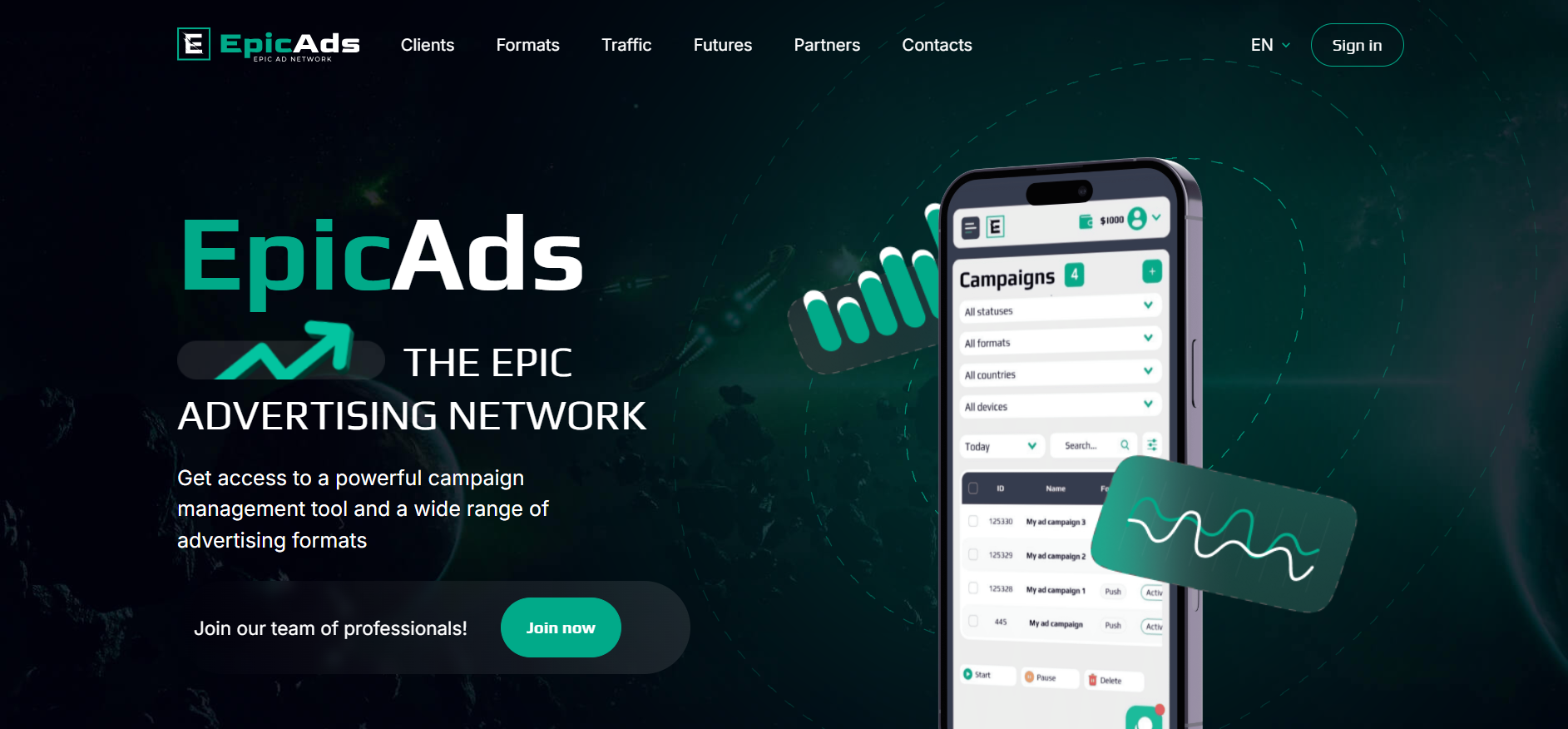
EpicAds.Net is a next-generation ad network launched in 2023 that helps publishers monetize website traffic through Push, InPage Push, and OnClick ads. The platform offers anti-fraud protection, high fill rates, real-time analytics, microbidding, and A/B testing to optimize ad performance. It supports high-converting niches such as Dating, Crypto, Nutra, Gambling, and Sweepstakes. Publishers can earn with weekly payouts starting from $50, making EpicAds.Net a reliable choice for performance-driven website monetization.
Payment Details:
- Payment methods: PayPal, Wire Transfer, Capitalist, USDT (TRC20)
- Payment cycles: Weekly and Bi-weekly options
- Minimum payout threshold: $50
- Payment Frequency: Weekly
Pros:
- Supports multiple high-converting ad formats (Push, InPage, and OnClick) to maximize website monetization and publisher revenue.
- Offers weekly payouts starting from $50, making it suitable for both new and growing publishers.
- Includes advanced targeting, anti-fraud protection, and real-time analytics to improve ad performance and campaign efficiency.
Cons:
- As a new ad network (launched in 2023), it has a shorter industry track record than more established competitors.
- Primarily performs best in Dating, Crypto, Gambling, Nutra, and Sweepstakes niches, making it less suitable for some content categories.
- Limited support for premium display and video advertising, as the platform mainly focuses on Push, InPage, and OnClick ad formats.
Best for: Publishers and adver;tisers seeking CPC-based monetization, fast weekly payouts, and high-converting Push, InPage Push, and OnClick ad formats.
2. Push.House
Push.House is a push-notification ad network founded in 2018 and based in Ukraine, monetizing more than 30 million active subscribers with roughly 600,000 clicks and 300 million impressions daily. It’s a strong choice for advertisers who want fast setup the platform doesn’t require extensive onboarding to launch a first campaign and it complements a broader push notification ad network strategy.
Payment Details:
- Minimum deposit: $50 minimum deposit (advertisers)
- Payment Methods: Card, Crypto, Wire
- Payment Frequency: Prepaid
Pros:
- Global reach across 120+ countries with locally accessible payment methods.
- Fast campaign setup with no complex signup requirements.
- Two flexible push formats (Classic Push and In-Page Push) to test different placements.
Cons:
- No officially published minimum deposit figure makes upfront budget planning harder than on more transparent platforms.
- Push-format monetization is increasingly restricted by browser policy changes, which can shrink addressable reach over time.
- Reporting and campaign management tools are less advanced than larger, venture-backed competitors.
Best For: Advertisers running push-notification campaigns who want global reach with locally accessible payment options.
3. Click Adu
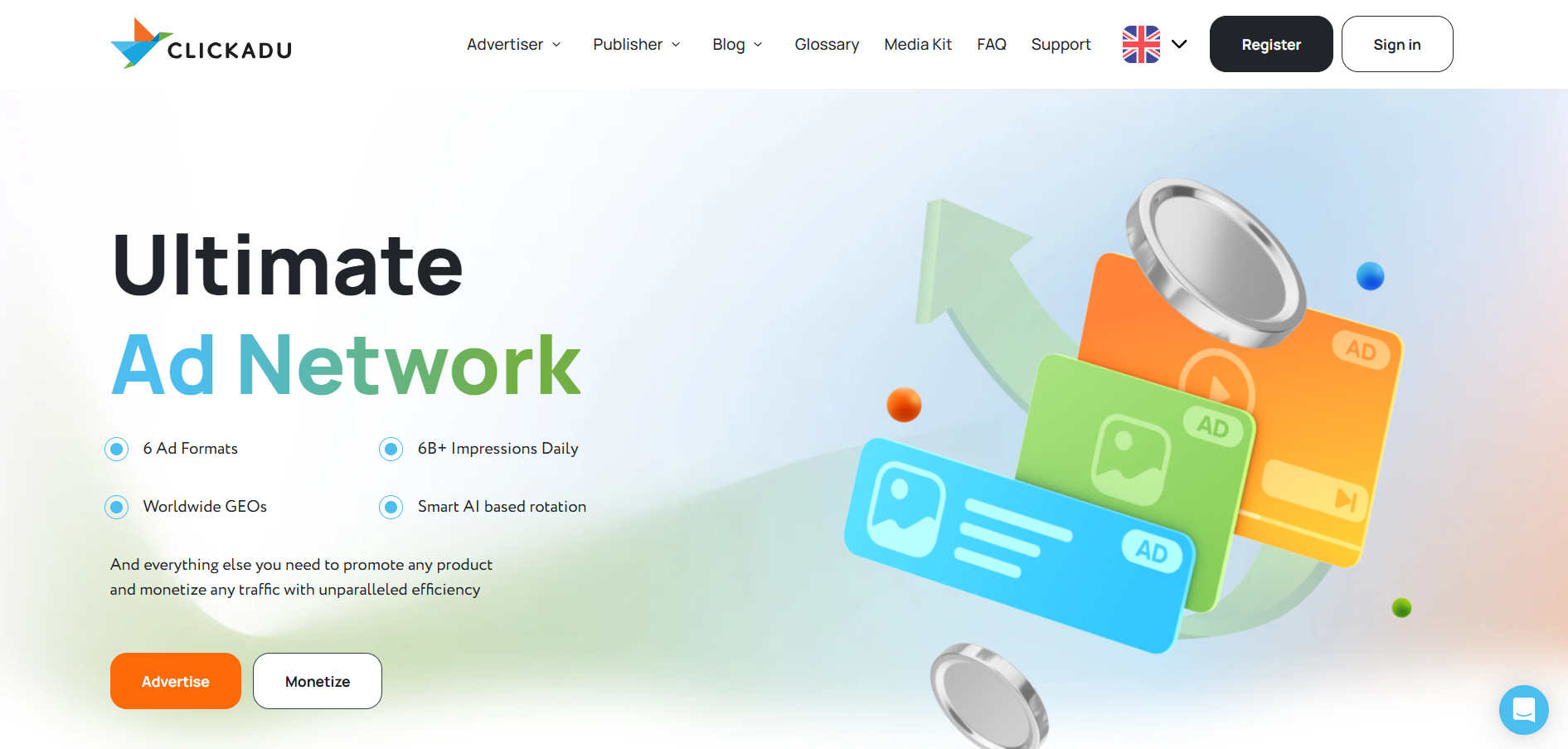
Click Adu is a publisher-focused ad network delivering around 4 billion daily ad impressions globally. It helps website and app owners monetize traffic using multiple ad formats, including pop-under, video, and banner ads. Approximately 3.6 million daily actions lead to purchases, indicating strong engagement potential. The network performs well even for sites with modest traffic. Click Adu supports both desktop and mobile traffic for flexible monetization. With easy setup and multiple ad options, it is a reliable choice for publishers seeking steady revenue.
Payment Details:
- Minimum deposit: $10
- Payment Methods: PayPal, Paxum, WebMoney, Crypto, Wire
- Payment Frequency: Weekly
Pros:
- Transparent, published CPM benchmarks by format help with upfront budget planning.
- Multiple payment options (wire transfer, PayPal, WebMoney, Paxum) suit advertisers across regions.
- Flexible payout scheduling (weekly, bi-weekly, or monthly) gives publishers on the same platform payment control, which reflects a generally advertiser-friendly account structure.
Cons:
- $100 minimum deposit is higher than several comparable self-serve pop/push networks.
- Approval process for new advertiser accounts is reported as stricter than some competitors.
- Best suited to pop-under and video formats rather than native or search-style placements.
Best For: Advertisers with limited traffic budgets who want a transparent, published CPM structure across multiple formats.
4. Primis
Primis is a video advertising unit that delivers native video placements with optimized timing and ad positioning, aiming to boost RPMs for publishers while keeping the experience non-intrusive for viewers. Its fully flexible native ad unit fits into a site’s existing design, making it a useful complement to a broader video ad network strategy.
Payment Details:
- Minimum Payouts : Custom / Contract Based
- Payment Methods: Wire Transfer
- Payment Frequency: Net-60
Pros:
- Native video ad unit adapts to a site’s existing design rather than forcing a fixed template.
- Strong anti-fraud protections aim to keep advertiser spend protected from invalid traffic.
- Positions itself around brand-safety and customer-focused standards in a space that can otherwise be low-trust.
Cons:
- Minimum budget and fee structure aren’t published prominently, requiring direct outreach to get exact figures.
- Better suited to publishers with meaningful video-capable inventory than pure text-based or utility sites.
- Fewer independent, up-to-date advertiser reviews exist compared to larger self-serve networks.
Best For: Advertisers and publishers prioritizing native video engagement with a focus on brand safety and fraud protection.
5. Twinred

TwinRed is a self-service, open-RTB ad network built around high-quality adult traffic, offering popunder, interstitial, and native ad formats alongside sophisticated targeting and bidding tools. It’s one of the few networks on this list offering interstitial ads specifically, alongside native ad network formats that give advertisers strong ROI across popular verticals.
Payment Details:
- Minimum Payouts : €50
- Payment Methods: Wire Transfer, Paxum, Crypto
- Payment Frequency: Weekly
Pros:
- Extensive targeting options (geo, device, OS, browser, IP range) support granular campaign control.
- Advanced macros let advertisers track performance down to the placement level.
- Real-time bidding (RTB) infrastructure supports competitive, market-rate pricing.
Cons:
- $100 Paxum minimum (or $500 via wire) is higher than several comparable pop/push-focused networks.
- PayPal funding requires reaching out to an account manager rather than being available as a self-serve option.
- Primarily focused on adult and mainstream verticals, limiting fit for brand-safety-sensitive advertisers.
Best For: Advertisers running adult or mainstream popunder and interstitial campaigns who want granular RTB targeting.
6. Click Adilla
ClickAdilla is a self-serve ad network with traffic across 240+ countries and 13 ad formats, offering premium adult and mainstream traffic sources with strong anti-fraud protection. It supports popunder, push, native, video, and banner formats, and includes a dedicated crypto-interest filter for advertisers targeting that specific crypto-focused vertical.
Payment Details:
- Minimum Payouts :$50
- Payment Methods: Paxum, PayPal, WebMoney, Crypto
- Payment Frequency: Weekly
Pros:
- Low $50 minimum deposit for card, Capitalist, or Paxum funding makes testing accessible.
- Personal account manager assigned from account creation, even for smaller advertisers.
- Fast moderation (typically under 15 minutes) gets campaigns live quickly.
Cons:
- Wire transfer requires a much higher $500 minimum than digital payment methods.
- No fixed CPC pricing is entirely auction-based, which can make budget forecasting less predictable.
- Real, effective testing budgets ($300+) are recommended over the bare $50 minimum for meaningful data.
Best For: Advertisers wanting to test multiple ad formats across a wide range of GEOs with a low upfront deposit.
7. Traffic Stars
TrafficStars is a self-serve adult ad network and exchange serving billions of daily ad impressions, letting advertisers purchase premium traffic in real time from a global publisher inventory. It emphasizes data-driven decision-making, offering automatic campaign optimization through neural network algorithms — a useful complement to a broader display ad network buy if you’re diversifying traffic sources.
Payment Details:
- Minimum Payouts : $100
- Payment Methods: Wire, Paxum, Capitalist, Crypto, ACH
- Payment Frequency: Weekly / Monthly
Pros:
- Automatic campaign optimization via neural network algorithms reduces manual bid management.
- Real-time statistics let advertisers quickly identify which placements and targeting options perform best.
- Smart targeting and pricing tools help control CPA goals directly within the dashboard.
Cons:
- $100 minimum deposit for e-wallets (and $500 for bank transfer) is higher than several comparable networks.
- Primarily focused on adult traffic, limiting fit for brand-safety-sensitive campaigns.
- Wire transfer withdrawal minimum of $1,000 is high relative to digital payment thresholds.
Best For: Advertisers running adult or mainstream campaigns who want real-time bidding with AI-driven optimization.
8. Tiktok Ads
TikTok Ads reaches over 1.5 billion monthly active users through in-feed ads, Spark Ads, TopView takeovers, branded hashtag challenges, and more, using a straightforward four-step campaign setup: audience, objective, budget, and creative. TikTok’s official minimums are lower than many advertisers assume, though effective testing budgets run considerably higher in practice.
Payment Details:
- Minimum Payouts : Minimum budget varies by region (typically $20–$50/day)
- Payment Methods: Card, PayPal, Bank Transfer
- Payment Frequency: Advertiser Billing
Pros:
- Official minimums ($50/day campaign, $20/day ad group) are genuinely accessible for small-budget testing.
- Wide range of ad formats (in-feed, Spark Ads, TopView, branded effects) suit different campaign objectives.
- Massive, highly engaged user base with strong purchase-intent signals reported directly by TikTok.
Cons:
- Meeting the official minimum doesn’t mean meeting the effective minimum — TikTok’s own guidance suggests budgets several times higher to properly exit the algorithm’s learning phase.
- Managed/reservation buying (TopView, Branded Hashtag Challenges) requires a separate, much larger commitment, often starting at $25,000+ per campaign.
- Frequent budget or creative changes reset the learning phase, requiring more disciplined campaign management than static-budget networks.
Best For: Brands and advertisers targeting Gen Z and younger Millennial audiences with short-form video creative.
9. Snapchat Ads
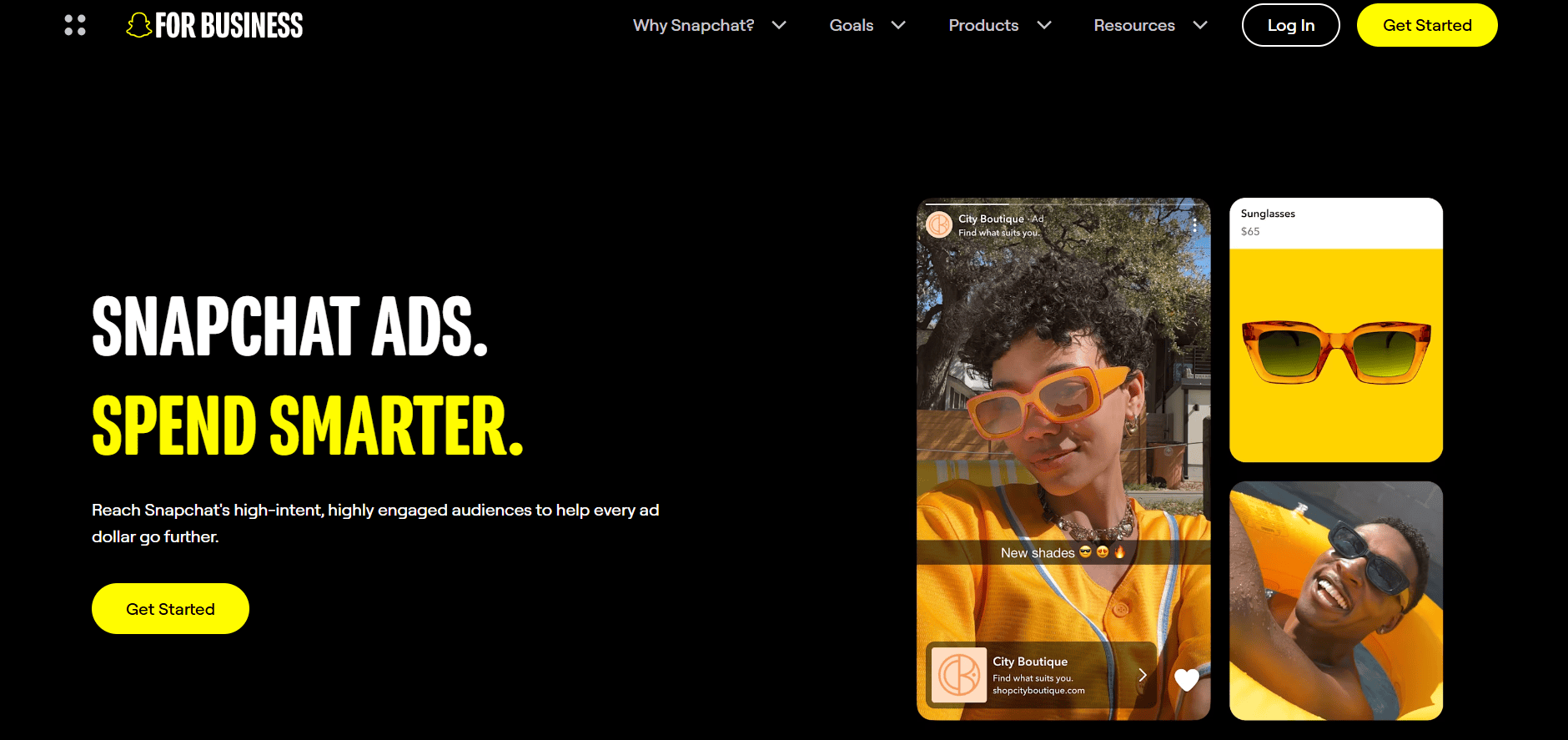
Snapchat Ads is a popular advertising platform focused on reaching millennials and Gen Z users. It allows advertisers to target audiences based on interests, behaviors, location, and other factors. The platform reaches approximately 319 million active users who are highly engaged. Snapchat Ads help brands connect with younger demographics and grow awareness among tech-savvy audiences. It supports a variety of ad formats designed to boost engagement and conversions. This makes it an ideal platform for advertisers aiming to build brand presence with younger generations.
Payment Details:
- Minimum Payouts : Minimum budget $5/day
- Payment Methods: Card, PayPal
- Payment Frequency: Advertiser Billing
Pros:
- Strong reach among Gen Z and younger Millennial audiences that some platforms struggle to engage.
- Self-serve platform supports low daily test budgets before committing to larger spend.
- Multiple ad formats (Snap ads, collection ads, story ads) suit different funnel stages.
Cons:
- Smaller overall audience than Meta or TikTok limits scale for broad awareness campaigns.
- Younger-skewing demographic isn’t a fit for every advertiser vertical (e.g., enterprise B2B).
- Ad creative requirements favor native, casual, in-app-style content over traditional polished ads.
Best For: Brands targeting younger demographics (Gen Z and younger Millennials) with visual, casual ad creative.
10. Twitter Business (Now X Busniess)
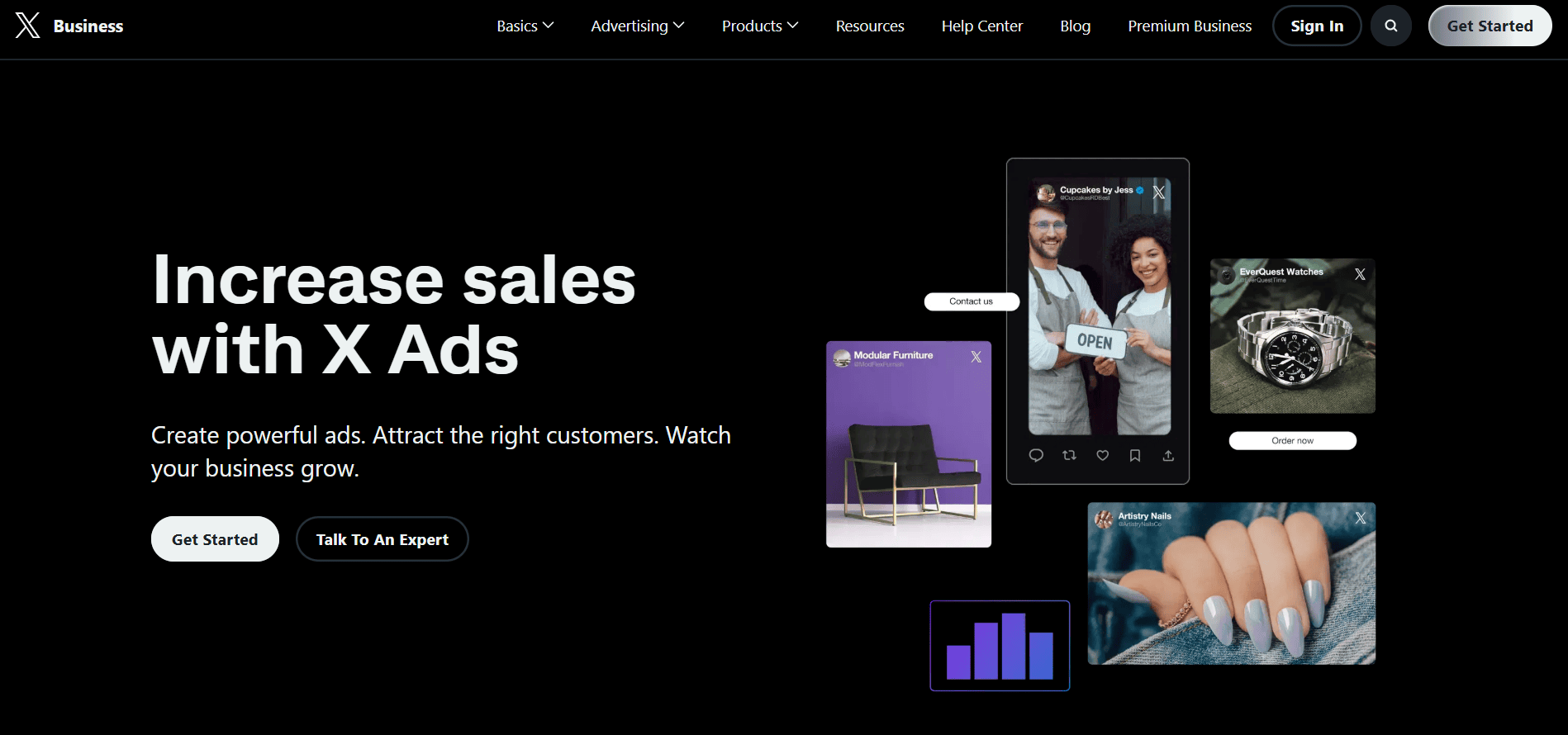
X Business offers more than 20 different advertising products, including Promoted Ads, Follower Ads, Twitter Amplify, Twitter Live, Polls, Twitter Takeover, Branded Hashtags, and Branded Notifications. It remains a strong channel for real-time, conversation-driven marketing tied to trending topics or live events, complementing broader PPC-billed campaigns elsewhere in a media plan.
Payment Details:
- Minimum Payouts : Minimum budget $5
- Payment Methods: Card
- Payment Frequency: Advertiser Billing
Pros:
- Excellent for real-time marketing tied to trending topics, launches, or live events.
- Conversation-based formats create genuine engagement rather than passive impressions.
- Keyword targeting lets advertisers reach users based on what they’re actively discussing.
Cons:
- Platform’s user base and ad revenue have been more volatile than competitors in recent years, adding planning uncertainty.
- Brand safety concerns have led some advertisers to reduce spend compared to prior years.
- Analytics and audience insights are less mature than Meta’s or Google’s reporting suites.
Best For: Advertisers running real-time, conversation-driven campaigns tied to trending topics or live events.
11. Microsoft Ads
Microsoft Ads is a search advertising platform that reaches up to 41 million customers across Microsoft and partner websites. It handles around 400 million monthly searches, providing extensive audience reach. The platform offers 15 different ad tools to enhance campaign strategies and improve performance. Advertisers can import campaigns from Google Ads and Facebook Ads to save time and optimize efforts. Microsoft Ads enables precise targeting and efficient ad management to drive better business outcomes. It is ideal for expanding the reach of search advertising beyond other major platforms.
Payment Details:
- Minimum Payouts : Minimum budget $5
- Payment Methods: Card, PayPal
- Payment Frequency: Prepay / Postpay
Pros:
- Lower average CPC than Google Ads in most verticals due to reduced auction competition.
- Import tool clones existing Google Ads campaigns directly into Microsoft Advertising, saving setup time.
- Reaches a demographic skewed toward desktop, professional, and older audiences some advertisers can’t get elsewhere.
Cons:
- Smaller total search volume than Google means a lower overall traffic ceiling.
- Targeting and automation tools, while improving, still lag behind Google Ads’ feature set.
- Fewer third-party integrations and reporting tools support Microsoft Advertising compared to Google.
Best For: Advertisers already running Google Ads who want to extend proven campaigns to lower-competition search inventory.
12. Ad Spy Glass
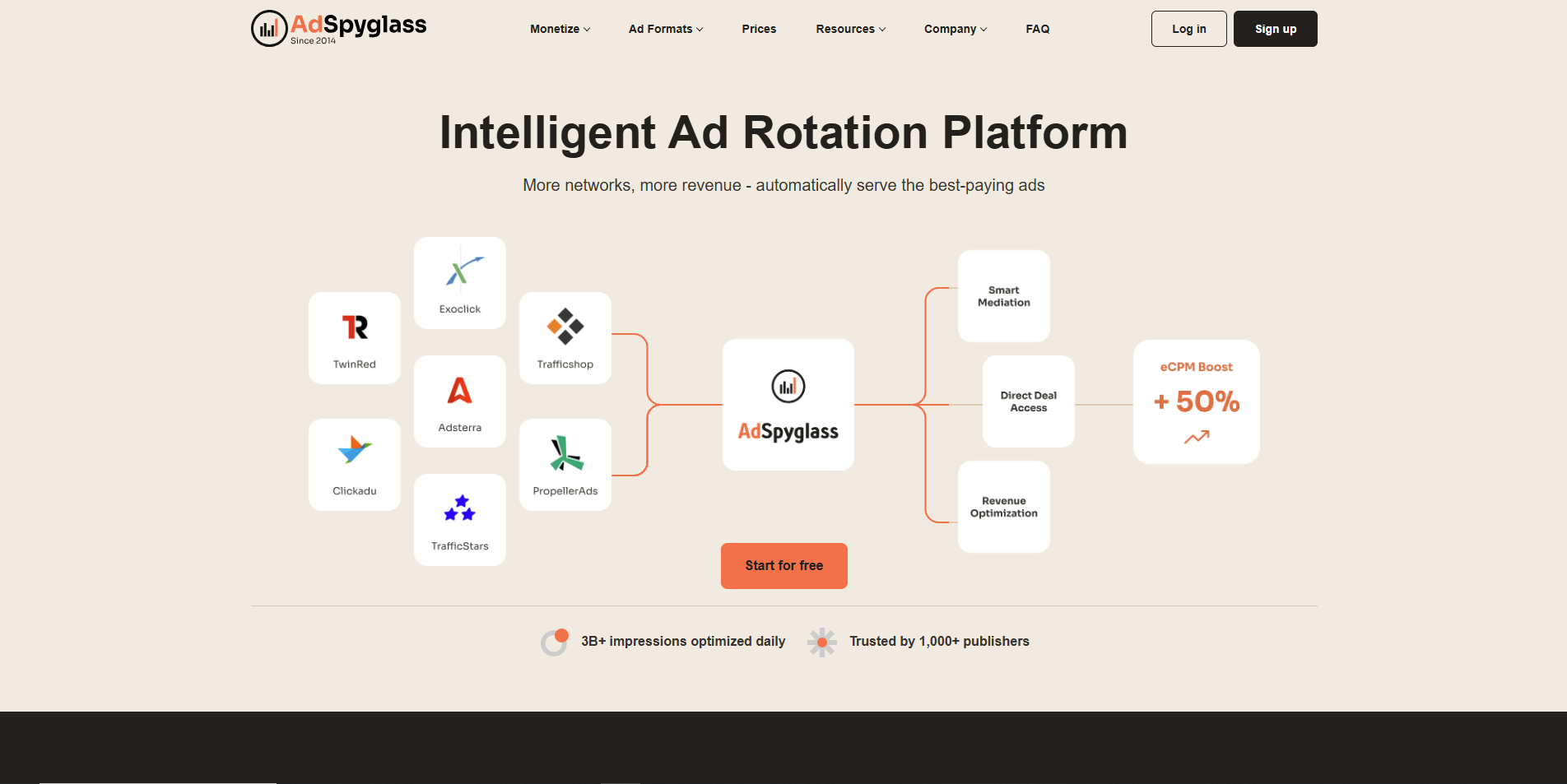
Ad Spyglass is an ad mediation and management platform that helps publishers maximize website revenue. It connects publishers with multiple ad networks and automatically selects the ad with the highest CPM. This ensures optimal earnings for every ad placement. The platform provides full control over ad inventory, enabling publishers to easily adjust and optimize campaigns. Ad Spyglass integrates with networks like AdCash, AdMaven, Propeller Ads, PopCash, and ZeroPark. It is continuously updated to provide the latest features and improved performance for publishers.
Payment Details:
- Minimum Payouts : $50
- Payment Methods: PayPal, Wire, Paxum, Payoneer, Crypto
- Payment Frequency: Monthly
Pros:
- Automatic CPM comparison across multiple connected networks maximizes publisher yield without manual tag-switching.
- Full control over ad inventory lets publishers adjust and improve placements as needed.
- Continuously updated platform keeps pace with newly added ad-network integrations.
Cons:
- Not intended for advertisers directly marketers looking to buy traffic need to register with Traforama, AdSpyglass’s advertiser-facing counterpart, instead.
- Value depends entirely on the quality and number of networks a publisher connects, not a fixed in-house marketplace.
- Adds a layer of technical setup compared to using a single ad network directly.
Best For: Publishers who want automated, real-time CPM comparison across several connected ad networks rather than manually testing each one.
13. Amazon Ads
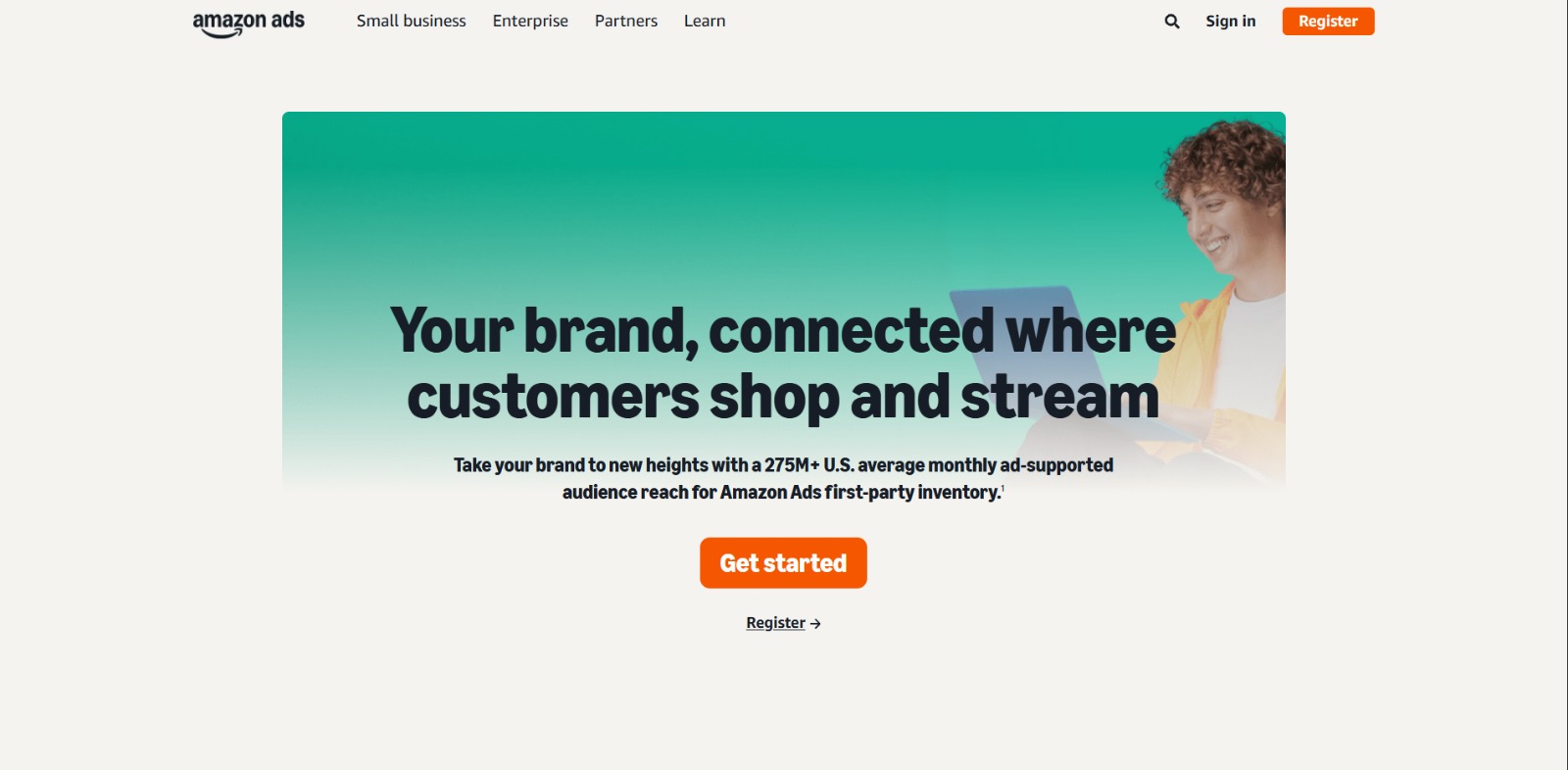
Amazon Ads is an advertising platform with over 300 million active accounts, offering deep insights into customer behavior and preferences. It allows advertisers to promote products, brands, and services through display, audio, and video ads. The platform supports programmatic ad buying via Amazon’s Demand-Side Platform (DSP) for precise targeting. Advertisers can access a variety of ad products and sponsorship options to effectively reach their audience. Amazon Ads operates in 18 countries, including Australia, Brazil, and India. It is ideal for brands looking to engage customers across multiple channels and drive measurable results.
Payment Details:
- Minimum Payouts : No fixed minimum (varies by campaign type)
- Payment Methods: Card, Bank Transfer
- Payment Frequency: Advertiser Billing
Pros:
- Access to high-intent shoppers actively browsing or purchasing, unlike interruption-based ad formats elsewhere.
- Detailed first-party purchase data supports precise targeting and attribution.
- Multiple ad types (display, video, audio, sponsored products/brands) available from one advertiser account.
Cons:
- Self-serve Sponsored Ads work best for sellers already active on Amazon’s marketplace, limiting fit for off-platform brands.
- Amazon’s DSP (programmatic) typically requires a larger negotiated commitment through an account manager, raising the entry bar.
- Reporting and attribution can be harder to reconcile with non-Amazon analytics platforms.
Best For: Retail and e-commerce brands, particularly those already selling products on Amazon’s marketplace.
14. Adroll
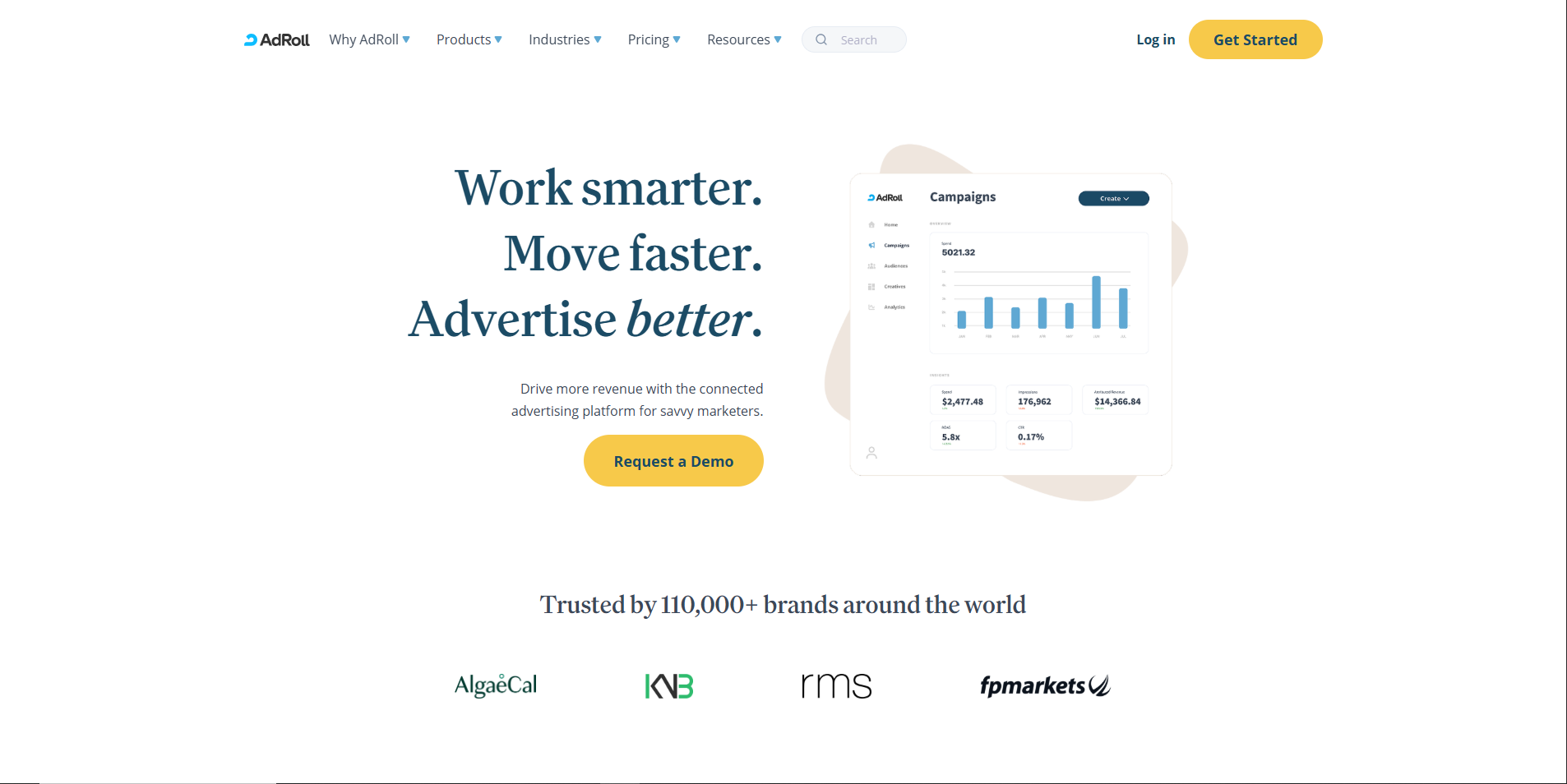
AdRoll is an advertising platform with over 10 years of data from millions of brands and billions of consumers, helping identify the right audience for your products. It offers tailored marketing plans to optimize campaign performance and achieve measurable results. The platform combines display ads with automated email campaigns to drive traffic and engagement. AdRoll’s unique approach tracks changes in customer preferences over time for precise targeting. Advertisers can reach audiences across multiple channels and devices. It is ideal for businesses seeking data-driven marketing and effective audience engagement.
Payment Details:
- Minimum Payouts : Minimum budget $50
- Payment Methods: Card
- Payment Frequency: Monthly Billing
Pros:
- Cross-channel retargeting (display + social + email) from a single unified dashboard simplifies campaign management.
- AI-driven optimization and audience segmentation reduce manual bid management.
- Deep integrations with major e-commerce platforms like Shopify and BigCommerce.
Cons:
- Primarily useful for retargeting existing site visitors, making it less effective for pure cold-audience prospecting.
- Reporting and attribution can double-count conversions already tracked in Google/Meta, complicating ROAS math.
- Budget-based pricing scales with spend and features, which can get costly for very small stores.
Best For: E-commerce brands wanting cross-channel retargeting across display, social, and email from one platform.
15. SiriusXM Media
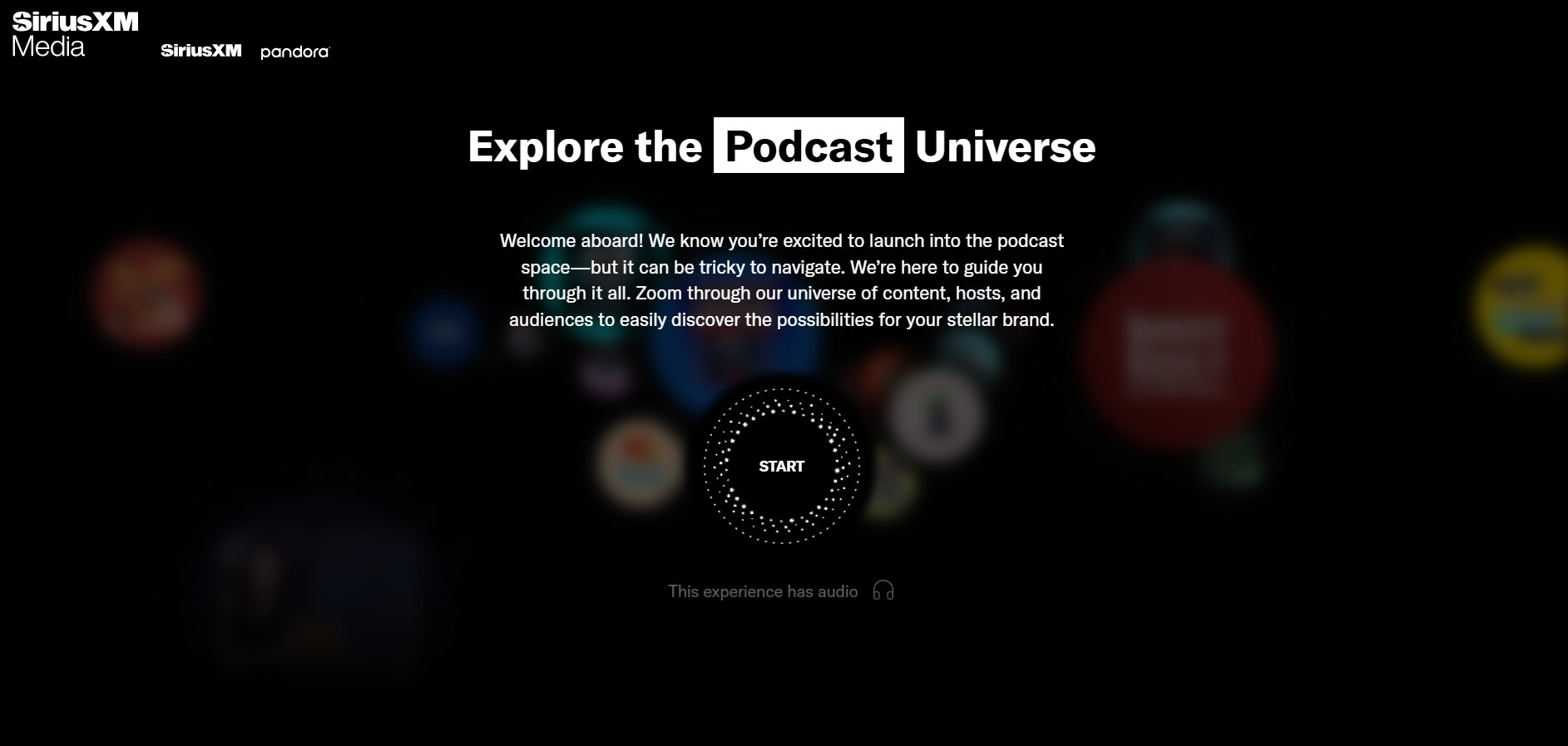
SiriusXM Media is the largest podcast advertising network in the US, reaching approximately 55 million podcast listeners through streaming audio, video, dynamic audio, and sequential audio placements. Its Podcast Ads product offers audience-based buying, contextual alignment, branded content, and exclusive show partnerships.
Payment Details:
- Minimum Payouts : Custom Enterprise Budget
- Payment Methods: Contract Billing
- Payment Frequency: Advertiser Billing
Pros:
- Massive reach within the podcast-listening audience specifically, a format many general ad networks don’t cover well.
- Multiple audio ad formats (dynamic, sequential, streaming) support different campaign goals.
- Branded content and exclusive show opportunities offer deeper integration than standard spot ads.
Cons:
- Enterprise-style, negotiated pricing makes it less accessible for small advertisers testing modest budgets.
- Podcast advertising generally requires longer lead times for creative production than standard display or social ads.
- Attribution for audio ads is inherently harder to measure precisely than click-based digital formats.
Best For: Brands specifically targeting podcast and audio-streaming listeners with larger, planned campaign budgets.
Future Trends Shaping Ad Networks for Advertisers in 2027
The advertising industry continues to evolve as AI-powered optimization, privacy-first targeting, and programmatic advertising become standard across leading ad networks. Advertisers are increasingly relying on first-party data and contextual targeting to reach highly relevant audiences while maintaining compliance with global privacy regulations. These advancements help improve campaign efficiency, reduce wasted ad spend, and generate stronger returns on investment.
Another notable trend is the growing adoption of native advertising, video ads, and automated bidding technologies that deliver more personalized user experiences. As competition increases, advertisers are focusing on performance-driven strategies that combine audience targeting with data-backed optimization. This shift is also influencing sectors such as high-paying ad networks for publishers and PPC advertising networks, where AI and real-time bidding continue to reshape digital advertising performance in 2027.
Final Thoughts
Ad networks provide a crucial link between advertisers and publishers, helping drive traffic, boost conversions, and fine-tune targeting at a scale that manual, site-by-site negotiation simply can’t match. With the right strategy and a realistic view of what a platform’s “minimum” budget actually buys you, ad networks can deliver high-quality traffic and genuinely cost-effective advertising, whether you’re a brand running TikTok and Snapchat campaigns or an affiliate testing performance offers on Galaksion or ClickAdilla.
Success in modern advertising requires a strategic mix. Advertisers must look beyond the giants and explore networks that offer precise targeting, innovative ad formats, and better cost efficiency for their verticals. By selecting the right partners from this list and leveraging their advanced tracking and optimization tools, you can transform your ad spend into a scalable revenue engine. The key is to start testing, analyze your data, and diversify your traffic sources to stay ahead of the competition, especially when using affordable ad networks for advertisers and high-ROI ad networks for small businesses.
Frequently Asked Questions (FAQs)
What is an ad network?
An ad network is a platform that connects advertisers with publishers, enabling advertisers to place ads across various websites and mobile platforms.
Why should I use an ad network?
Ad networks offer targeted advertising, efficient ad placement, and real-time data analysis to optimize campaigns and increase conversions.
What are common targeting options in ad networks?
Targeting options include location (GEO), platform, device, age, gender, interests, and retargeting.
Can I track the performance of my ads through ad networks?
Yes, ad networks provide reporting tools that allow you to track clicks, impressions, conversions, and other key metrics.
Are ad networks only for big companies like Google and Facebook?
No, while Google and Facebook dominate the market, there are many other ad networks available, offering a variety of advertising solutions for businesses of all sizes.
Which ad networks are best for affiliate marketers specifically?
Push.House, ClickAdu, TwinRed, ClickAdilla, TrafficStars, and Galaksion are commonly used by affiliates for performance-based verticals like dating, sweepstakes, nutra, and finance, thanks to low deposits and flexible CPA/CPC pricing. Larger platforms like TikTok, Snapchat, and Amazon Ads are better suited to brand advertisers and e-commerce sellers rather than pure affiliate offers.
What’s the difference between self-serve networks and managed platforms like SXM Media or Amazon DSP?
Self-serve networks (ClickAdu, ClickAdilla, TrafficStars, Galaksion, etc.) let advertisers set up and launch campaigns directly through a dashboard with low minimum deposits, while managed platforms like SXM Media or Amazon’s DSP typically require working with an account manager and committing to a larger, negotiated budget. The trade-off is speed and low entry cost versus dedicated optimization support and premium inventory access.
Does meeting a network’s minimum budget guarantee good campaign performance?
No, as TikTok’s own advertiser guidance makes clear, meeting the platform’s official minimum keeps a campaign eligible to run, but effective optimization (exiting the algorithm’s “learning phase,” for example) typically requires a budget several times higher than the stated floor. This pattern holds loosely across most auction-based networks, not just TikTok.
