
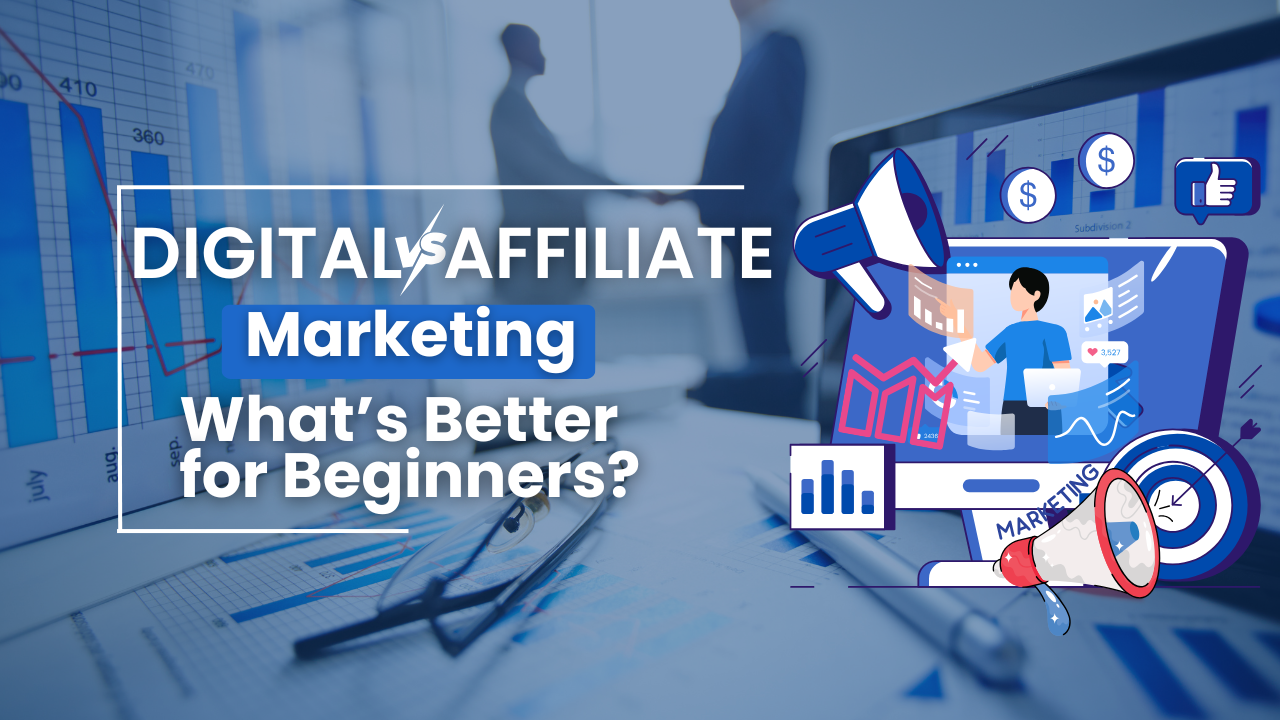
Affiliate marketing is a performance-based model where you earn a commission for promoting someone else’s product through a tracked link, with no inventory, no brand to manage, and no upfront product cost. Digital marketing is the broader discipline (SEO, PPC, content, social, email) used to promote any brand, including your own. Affiliate marketing is really a specialized application of digital marketing, not a separate field. For most beginners, affiliate marketing is the lower-risk entry point because it teaches core digital marketing skills through direct, measurable feedback, and those skills transfer directly if you later move into brand-side digital marketing.
Over the last several years, I’ve built affiliate websites, managed SEO campaigns, and worked on content-led marketing projects. The question I hear most often is whether beginners should start with affiliate marketing or digital marketing. From working across both affiliate and digital marketing campaigns, I’ve found that beginners rarely need to choose one path forever. Most beginners don’t actually need to pick a lane forever. They need to understand what each path demands right now.
What Is Affiliate Marketing?
Affiliate marketing is a three-party business model: a seller (who owns a product), an affiliate (who promotes it), and a customer (who buys it). When a customer purchases through the affiliate’s tracked link, the affiliate earns a commission at no extra cost to the buyer.
Affiliates are typically paid one of three ways:
- Pay-per-sale, commission on a completed purchase (the most common model, used by Amazon Associates and most ClickBank offers).
- Pay-per-lead, payout when someone completes an action, like a free trial signup; common in software and finance.
- Pay-per-click, payout per click rather than sale; only practical once you already have significant traffic volume.
Most affiliate marketing today happens through blogs, YouTube, email lists, or social content. It doesn’t have to be digital, though offline methods like flyers, business cards, or print placements still work. One documented example: a ClickBank affiliate generated meaningful sales for the product “The Lost Ways“ by placing a promotion in Natural Grocers, a print publication, rather than online at all.
What are the benefits of affiliate marketing?
Affiliate marketing offers several advantages I’ve experienced directly building my own campaigns. Over time, I’ve come to realize that it’s one of the most accessible ways to earn online; you don’t need to invest in creating your own product, managing inventory, or dealing with logistics. Instead, you simply partner with brands and earn a commission for every sale or lead you generate through your marketing efforts
- Low startup cost: Most networks are free to join, and you never touch a product or inventory, so there’s almost nothing standing between you and your first campaign.
- Passive-income potential: One of affiliate marketing’s biggest strengths is that evergreen content can continue generating commissions months or even years after publication with only periodic updates.
- Flexibility: I’ve valued being able to build campaigns from anywhere, on my own schedule, without answering to anyone else’s timeline.
- Access to established networks: Programs like ShareASale, CJ Affiliate, ClickBank, and Amazon Associates mean I never run out of products worth promoting.
- Scalability: Once one niche starts working, scaling into adjacent niches has been straightforward in my own experience.
What Is Digital Marketing?
Digital marketing is the umbrella strategy for promoting a product, service, or brand across online channels: SEO, paid ads, content, social, and email working together to drive traffic and convert it into revenue. I think of it as the operating system beneath almost every online business model, including affiliate marketing itself. It covers five core disciplines:
| Channel | What It Does |
|---|---|
| SEO | Improves rankings in organic (unpaid) search results |
| PPC | Paid ads where you pay per click (Google Ads, Meta Ads) |
| Content Marketing | Blogs, videos, guides that build trust before a sale |
| Social Media Marketing | Builds audience and engagement on platforms like Instagram or LinkedIn |
| Email Marketing | Owned-audience channel for nurturing and converting subscribers |
What are the benefits of digital marketing?
Digital marketing scales in a way few other business skills do, and it offers several advantages I’ve come to rely on. Unlike many traditional skills that require you to trade more time for more results, digital marketing lets you build systems, content, campaigns, and funnels that keep working and reaching new people long after you’ve set them up.
- Scalability: The same strategy that grows a small blog can grow a national brand; the core playbook stays the same, just with a bigger budget behind it.
- Multi-channel reach: You connect with audiences across search, social, email, and paid ads at once, so no single channel makes or breaks your results.
- Data-driven decisions: Analytics let you track ROI and user behavior instead of guessing, so every dollar goes where it actually performs.
- AI-ready optimization: Structuring content with semantic keywords makes it far more likely to surface in both classic search results and AI-generated answers.
- Brand credibility: Consistent, credible content builds a level of trust over time that a single link or one-off promotion never will.
When one channel underperforms, I’m never fully dependent on it, and I make every decision from analytics, not guesswork, because tracking ROI and user behavior tells me exactly where to spend the next dollar.
Key Differences: Affiliate Marketing VS Digital Marketing:
| Feature | Affiliate Marketing | Digital Marketing |
| Goal | Earn commissions through referrals | Promote a brand or product directly |
| Cost | Low startup cost | Medium to high |
| Income Type | Performance-based | Direct revenue |
| Tools | Amazon Associates, CJ Affiliate, ClickBank, ClickMeter | SEMrush, Google Ads, HubSpot, Jasper AI |
| Skill Required | Content creation, marketing | SEO, PPC, analytics |
| Ownership | Dependent on the network | Full control over campaigns |
Rather than viewing these as competing models, I see affiliate marketing as a specialization within the broader field of digital marketing. Each complements the other by addressing different business goals.
Which Strategy Is Better for Beginners in 2026?
For most beginners, I recommend starting with affiliate marketing, and here’s my reasoning:
- Lower risk of entry: It demands the least capital and the fewest technical skills, so the risk of an expensive early mistake is low.
- Faster hands-on learning: Affiliate marketing ends up teaching you real digital marketing, SEO, content strategy, and audience psychology through direct feedback, since every published post either converts or it doesn’t.
- A natural next step: Once those fundamentals are solid, layering in paid ads, email funnels, and AI-driven optimization has always felt like a progression rather than a separate career.
- Where digital marketing wins: It asks for more technical investment upfront, but it rewards you with faster business revenue and stronger long-term control once you have the skills.
What I’ve noticed personally is that beginners who start with affiliate marketing tend to arrive at digital marketing with real instincts already built in, rather than learning everything from theory first.
Digital Marketing vs Affiliate Marketing: Which Is More Profitable?
Profitability comes down to your time horizon, not which model is objectively “better.” In my experience, digital marketing wins on short-term revenue; paid campaigns can generate sales within days, while affiliate marketing wins on long-term passive income, since a well-ranked article keeps earning long after you’ve stopped actively working on it.
Digital marketing also scales more aggressively through paid budgets and analytics-driven targeting, whereas affiliate income scales more slowly through compounding content and authority. My own strategy has been to diversify across both, because relying on a single income stream, one ad account, or one affiliate network has burned me before when a platform changed its rules overnight.
How to Get Started With Affiliate Marketing
Based on successful affiliate sites I’ve built, this sequence provides beginners with a strong foundation.
- Pick a niche: Choose one you can realistically write about for a year, ideally where AI search tools already surface strong buyer-intent content.
- Join a network: Amazon Associates, ShareASale, CJ Affiliate, ClickBank, or BitMedia gives you access to products and creative assets.
- Build a website or blog: Structure it around semantic keywords and the kinds of questions people actually ask AI search tools now.
- Create content: Publish blogs, YouTube videos, newsletters, and social posts that genuinely educate before they sell.
- Track performance: Use ThirstyAffiliates, ClickMeter, or Pretty Links to monitor every click and conversion.
- Optimize for AI and SEO: Structure every post with clear entities, FAQs, and headings so both Google and AI engines can extract your answers cleanly.
How to Get Started With Digital Marketing
Getting started with digital marketing follows the same kind of clear sequence:
- Learn the fundamentals first: SEO, PPC, content marketing, social media, and email. Trying to run paid ads. One of the most common beginner mistakes is investing in paid advertising before understanding customer intent, analytics, and conversion tracking.
- Set up analytics early: Google Analytics, Search Console, and Tag Manager let you track real data from day one instead of guessing after the fact.
- Plan multi-channel campaigns: Blend organic and paid strategies, since relying on only one channel leaves you exposed.
- Use AI-powered tools wisely: Jasper AI, Canva, Grammarly, and HubSpot speed up production, but I still review and personally edit everything before it publishes.
- Measure what matters: Track click-through rate, conversion rate, ROI, and engagement to know what’s actually working.
- Structure for both search types: Use semantic keywords and entities so content performs across traditional search and AI-powered platforms.
Common Misconceptions:
Affiliate marketing and digital marketing overlap so much that a lot of confusion comes from a handful of repeated myths rather than any real technical difference. Some of these assumptions come from outdated ideas about how affiliate programs used to work; others come from treating ‘digital marketing’ as if it only means paid ads.
- “Affiliate marketing is a shortcut, not real marketing.” In practice, affiliates use the same SEO, content, and email tactics as any digital marketer; the only difference is who owns the product.
- “Digital marketing always requires a big budget.” Organic channels, SEO, content, and email can run at low cost; paid ads are optional, not mandatory.
- “Affiliate marketing only works online.” It doesn’t. Offline placements (print, flyers, referrals) are still a valid affiliate channel, as shown by cases like the Natural Grocers print promotion mentioned above.
- “The two are competing career paths.” They overlap heavily. Someone skilled in digital marketing typically converts better as an affiliate since the underlying skills, audience research, content, and tracking are the same.
Conclusion
After working with both business models, I no longer view affiliate marketing and digital marketing as competing paths. Affiliate marketing is one of the most practical ways to develop real-world digital marketing skills because every article, campaign, and conversion provides measurable feedback. Those same skills, SEO, content strategy, analytics, audience research, and optimization- transfer directly into broader marketing careers, agencies, and online businesses. Audience research transfers directly into broader marketing careers and businesses.
Frequently Asked Questions (FAQs)
Can a digital marketer do affiliate marketing?
Yes, in my experience, digital marketers often perform better at affiliate marketing than beginners do. SEO, content creation, email campaigns, and social media skills translate directly into stronger affiliate conversions. Understanding affiliate networks and tracking tools on top of that skill set tends to produce more consistent traffic and, ultimately, more income.
What is better, digital marketing or affiliate marketing?
Neither is objectively better. Affiliate marketing suits beginners seeking a low-cost way to learn and earn, while digital marketing is better suited to building long-term brands, businesses, and careers. Many professionals successfully combine both.
What is the highest-paying skill in digital marketing?
SEO, paid advertising, conversion rate optimization (CRO), marketing analytics, and marketing automation are among the highest-paying digital marketing skills because they have a direct impact on business revenue.
Is affiliate marketing still worth it in 2026?
Yes. Affiliate marketing continues to grow because businesses increasingly rely on performance-based customer acquisition. Success, however, depends on producing trustworthy, high-quality content rather than publishing large quantities of low-value material.
Can I start both digital marketing and affiliate marketing simultaneously?
Yes. Starting both simultaneously allows you to apply digital marketing skills while earning through affiliate promotions. Just avoid trying to master every marketing channel at once; focus on one traffic source before expanding.
How much can beginners earn in affiliate marketing?
Earnings vary widely by niche, audience size, and consistency, and I’ve seen the full range personally. Most beginners start with small, inconsistent commissions that grow slowly over months. Competitive niches like tech or finance can produce significant income, but only with sustained optimization and real content investment.
Do I need a website for affiliate marketing?
A website helps, but it isn’t strictly required. I know affiliates who earn solely through YouTube, social media, or email. That said, in my own experience, a website gives you the most control, the strongest long-term SEO advantage, and the clearest path to scaling.
Which skills are essential to succeed in both?
Content creation, SEO, analytics, social media, and email marketing form the core skill set for both paths, based on everything I’ve built. Understanding AI tools and semantic keyword structuring boosts visibility and conversions across the board. Continuous learning isn’t optional anymore; Google’s update pace in 2026 makes it a requirement for staying visible long-term.
