

For most DIY creators, a mix of Amazon Associates (breadth), Home Depot or Lowe’s (home improvement), and one or two niche specialists (like Cricut for crafters or Etsy for handmade/decor content) covers the widest range of projects with the least effort. We researched the best DIY affiliate programs and concluded that Amazon Associates, Home Depot, Lowe’s, Cricut, CreateForLess, Scrapbook.com, Skillshare, AliExpress, Darn Good Yarn, Creativebug, Etsy, and Michaels are the best choices.
If you write tutorials, film project videos, or run a Pinterest board full of home and craft ideas, you already have what most affiliate marketers spend years building: an audience that’s actively planning to buy something. DIY affiliate marketing takes advantage of that. Someone reading “how to build a raised garden bed” isn’t just curious; they’re about to buy wood, screws, and a drill, and your link can be the one that gets the sale.
In this guide, we compared 12 of the best DIY affiliate programs for 2026 across tools, craft supplies, home improvement, and DIY education. Commission rates, cookie windows, and program eligibility change often, sometimes with only a week’s notice, so treat every number here as a directional guide and confirm the current terms on each program’s official page before you build content around it.
What is a DIY Affiliate Program?
A DIY affiliate program is a partnership that allows creators to earn a commission by promoting DIY-related products or services through unique affiliate links. When someone clicks the link and completes a qualifying purchase or action, the creator earns a commission. If they buy within the cookie window, anywhere from a few hours to 30+ days depending on the program, you get credited for the sale, even if they didn’t buy immediately.
DIY affiliate programs split roughly into two camps.
| Type | How It Pays | Examples |
| Physical-product programs | A percentage of what someone spends on tools, materials, and supplies | Home Depot, Michaels, Amazon |
| Digital-product programs | A bounty or share when someone signs up for a class or subscription | Skillshare, Creativebug |
Example: A woodworking tutorial on building a bookshelf might link to a cordless drill, a circular saw, wood clamps, and a can of stain—four separate products, four separate opportunities to earn a commission from one piece of content.
Does DIY Affiliate Marketing Still Work in 2026?
Yes. DIY content has a structural advantage over most other affiliate niches: the connection between content and product is direct and obvious. Nobody reads a tutorial on staining a deck out of idle curiosity; they’re planning a project and need to know what to buy.
A few reasons this niche continues to perform well:
- Project-based buying intent. Someone searching “how to build a DIY raised garden bed” is closer to purchasing than someone browsing a general “best tools” listicle.
- Multiple products per piece of content. A single tutorial can naturally recommend five or six products: the wood, the tools, the finish, and the hardware, multiplying your earning potential per post.
- Broad category coverage. Crafting, woodworking, home improvement, sewing, and decor each have their own dedicated affiliate programs, so you’re rarely stuck with one option.
- Evergreen search demand. Project tutorials (how to build, how to make, how to fix) tend to keep getting search traffic for years, unlike trend-driven content.
Because commission rates and terms shift, it’s worth diversifying across several programs rather than relying on one retailer. If a program cuts its rate or changes its cookie window overnight, which has happened before with major retailers, your income doesn’t collapse if it’s spread across two or three sources.
How to Choose the Right DIY Affiliate Program
Based on our research in affiliate programs, before joining a program, run it through these seven factors:
| Factor | What to Check | Why It Matters |
| Product fit | Does it match your content? | Better relevance means higher click-through and conversion |
| Commission | Percentage or fixed bounty | Determines your potential earnings per sale |
| Cookie duration | Hours vs. days | Affects how much credit you get for slow decision-makers |
| Product price | Low vs. high ticket | A high commission on a cheap item may earn less than a low commission on an expensive one |
| Attribution | Exact product vs. wider cart | Some programs pay only on the linked item; others pay on the whole cart |
| Payout | Threshold + payment method | Affects how often and how easily you actually get paid |
| Geographic availability | Where can you promote it? | A program may only pay commissions on sales from certain countries |
12 Best DIY Affiliate Programs In 2026:
Here is the list of the top 12 DIY affiliate programs in 2026:
- Amazon Associates
- Home Depot Affiliate Program
- Lowe’s Affiliate Program
- Cricut Affiliate Program
- CreateForLess
- Scrapbook.com Affiliate Program
- Skillshare Affiliate Program
- AliExpress
- Darn Good Yarn
- Creativebug
- Etsy
- Michaels Affiliate Program
1. Amazon Associates
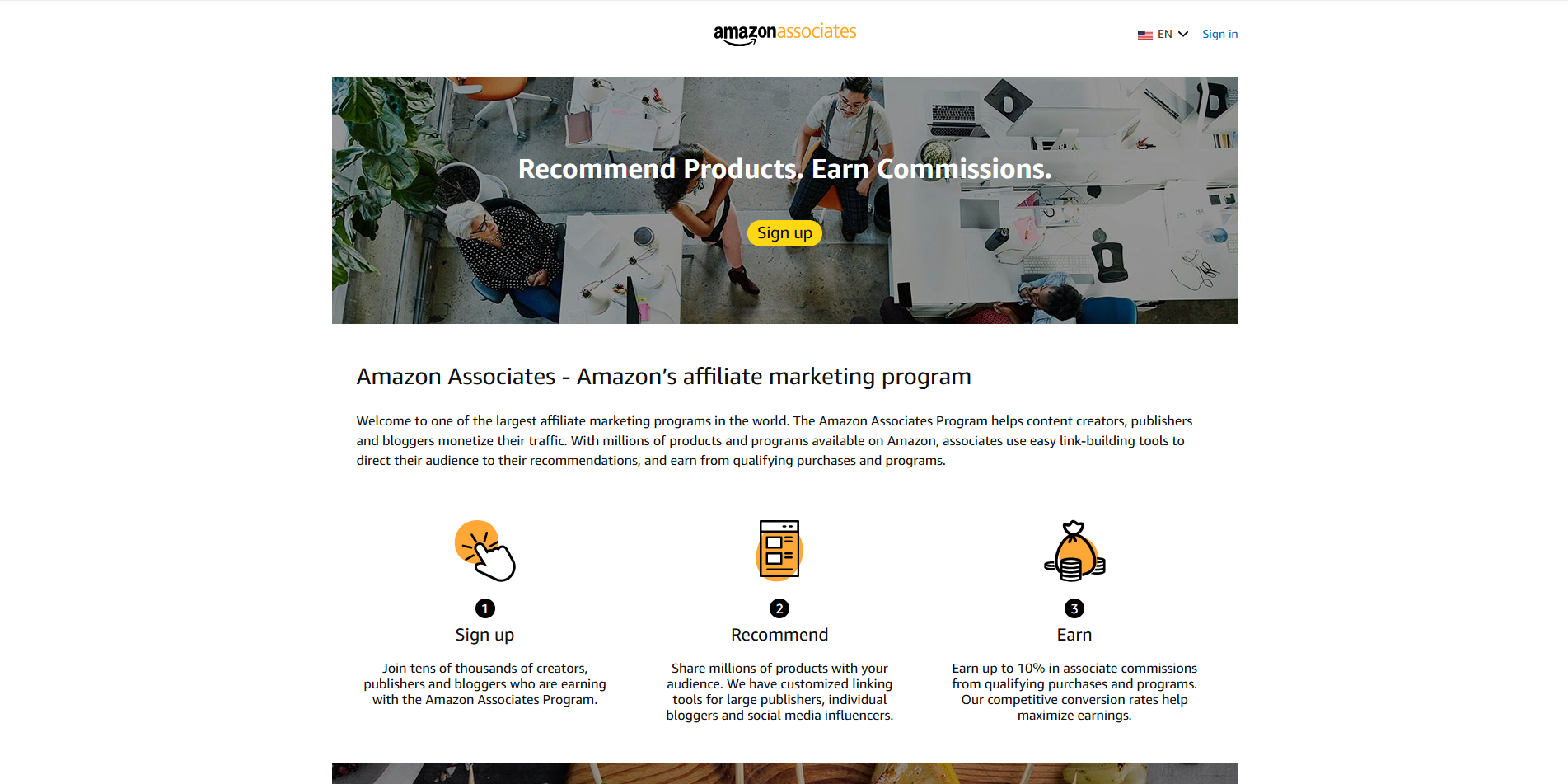
Amazon Associates is the affiliate arm of the world’s largest online retailer, giving creators access to almost every tool, material, or craft supply imaginable under one program. For DIY creators specifically, this breadth means a single tutorial can link to lumber, hardware, power tools, and finishing supplies without ever sending a reader to a second site. It’s also usually the first program new creators apply to, since the approval process is simpler than most specialty retailers.
Key Information
| Feature | Details |
| Approval Difficulty | Easy/Moderate |
| Commission Model | Category-based percentage |
| Reported Rates | ~3% (Tools & Home Improvement), ~4.5% (Kitchen) |
| Cookie Window | 24 hours (extends if item is added to cart) |
| Attribution | Whole cart within cookie window |
| Best Content Types | Materials lists, tool roundups, “what I used” project breakdowns |
Pros
- Unmatched product selection across every DIY category
- High buyer trust in Amazon’s checkout experience
- Simple application and easy integration with most CMS platforms
- Cart-wide attribution means unrelated purchases still count within the window
Cons
- Commission rates have dropped significantly since the program’s early years
- A short 24-hour cookie window means late buyers often go uncredited
- Requires real traffic volume to earn meaningfully
- Category rates vary widely and can change with little notice
2. Home Depot Affiliate program
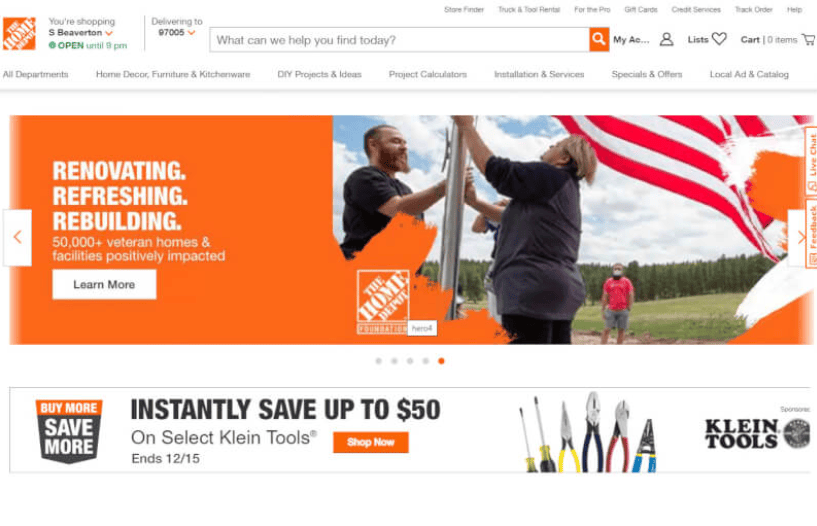
Home Depot’s affiliate program, run through the Impact network, covers tools, building materials, appliances, and a larger decor and outdoor living catalog than most creators expect. It’s one of the strongest fits for content built around real renovation and repair projects, since readers researching a purchase this large tend to convert at a higher rate than casual browsers. The program is a natural companion to more general retailers like Amazon, since it carries brand names and bulk materials that Amazon often doesn’t stock.
Key Information
| Feature | Details |
| Approval Difficulty | Moderate |
| Commission Model | Category-based percentage |
| Reported Rates | ~1%–8% |
| Cookie Window | 24 hours |
| Exclusions | In-store purchases, gift cards, and special orders typically don’t count |
| Best Content Types | Tool comparisons, renovation walkthroughs, project cost breakdowns |
Pros
- Deep catalog across tools, building materials, and appliances
- Strong brand trust for renovation and repair content
- Complements general retailers with bulk and specialty materials
- Well suited to research-heavy, high-intent content formats
Cons
- Short 24-hour cookie window
- In-store and special-order purchases generally excluded from commission
- Commission rates vary widely by category
- Less useful for craft-focused content outside home improvement
3. Lowe’s Affiliate program

Lowe’s covers much of the same territory as Home Depot: tools, building materials, appliances, and outdoor garden supplies, making it a natural point of comparison rather than a wholly different option. Where it tends to stand apart is in its appliance and outdoor-living catalog, which is often deeper than Home Depot’s for creators covering landscaping, patios, and yard projects. Because big-box retailers periodically shift their affiliate network partnerships and payout terms, Lowe’s specific commission structure is worth confirming directly rather than assuming it mirrors a competitor.
Key Information
| Feature | Details |
| Approval Difficulty | Moderate |
| Commission Model | Category-based percentage |
| Reported Rates | Varies; verify directly |
| Cookie Window | Varies; verify directly |
| Differentiator | Stronger appliance and outdoor-living catalog than Home Depot |
| Best Content Types | Landscaping, patio builds, seasonal outdoor DIY |
Pros
- Strong appliance and outdoor-living product selection
- Useful side-by-side pairing with Home Depot for price comparisons
- Broad national brand recognition and buyer trust
- Solid fit for landscaping and yard-focused content
Cons
- Commission and cookie terms are less consistently published than Home Depot’s
- Network affiliations for big-box retailers shift periodically
- Catalog overlaps heavily with Home Depot, limiting differentiation
- Requires direct verification before quoting specific numbers
4. Cricut Affiliate Program
9. Darn Good Yarn
Darn Good Yarn specializes in yarn and fiber-craft supplies with a clear emphasis on ethically sourced and sustainable materials, which resonates strongly with eco-conscious crafting audiences. This is a genuinely niche program that won’t fit a general DIY blog, but it can perform very well for creators specifically covering knitting, crochet, and fiber arts. Because sustainability is central to the brand’s identity, content that highlights sourcing and material quality tends to convert better than generic product placement.
Key Information
| Feature | Details |
| Approval Difficulty | Easy |
| Commission Model | Varies; verify directly |
| Reported Rates | Not consistently published; confirm before use |
| Cookie Window | Varies verify directly |
| Best Content Types | Yarn-along and process videos, sustainable-crafting content, product-focused fiber tutorials |
Pros
- Strong resonance with eco-conscious crafting audiences
- Genuinely niche with low competition for fiber-arts creators
- Sustainability angle supports higher-trust content
- Easy approval process
Cons
- Won’t fit a general DIY blog or broad crafting content
- Commission and cookie terms aren’t consistently published
- Smaller catalog than general craft retailers
- Limited to knitting, crochet, and fiber-arts niches specifically
10. Creativebug
Creativebug operates on a subscription model for craft classes, functioning much like Skillshare as a natural pairing with product-focused content rather than a standalone monetization strategy. It tends to skew toward higher-skill, technique-driven crafts, which fits well with tutorials that teach a process rather than simply list materials. Because subscription-based affiliate programs sometimes shift between a one-time bounty and a revenue-share structure more often than flat-rate product programs, current terms are worth verifying directly before publishing specific numbers.
Key Information
| Feature | Details |
| Approval Difficulty | Easy–Moderate |
| Commission Model | Subscription-based (bounty or revenue share; verify current structure) |
| Reported Rates | Not consistently published; confirm before use |
| Cookie Window | Varies; verify directly |
| Best Content Types | Class recommendations alongside project tutorials, “learn this technique” content for higher-skill crafts |
Pros
- Complements physical-product programs well
- Strong fit for higher-skill, technique-driven content
- No shipping or inventory concerns since it’s fully digital
- Appeals to readers looking to build a repeatable skill
Cons
- Payout structure changes more often than flat-rate product programs
- Requires readers to commit to a subscription, a higher bar than a single purchase
- Commission and cookie terms aren’t consistently published
- Narrower audience than general craft-supply programs
11. Etsy
Etsy’s affiliate program pays a standard commission on qualifying sales and carries one of the longer cookie windows in this guide, making it a strong anchor for handmade and decor content specifically. Its catalog spans handmade goods, personalized gifts, home decor, and craft supplies, and its lower percentage compared to some craft-specific programs is offset by broad buyer trust and Etsy’s established checkout experience.
Key Information
| Feature | Details |
| Approval Difficulty | Easy–Moderate |
| Commission Model | Flat percentage |
| Reported Rates | ~4% |
| Cookie Window | ~30 days (desktop/web), ~7 days (app) |
| Restriction | Affiliates generally cannot earn standard commission on sales from their own shop (use Etsy’s separate “Share & Save” tool instead) |
| Best Content Types | Gift guides, “haul”-style content, handmade and decor roundups |
Pros
- Broad catalog spanning handmade goods, gifts, decor, and supplies
- Strong existing buyer trust in Etsy’s checkout experience
- Long cookie window relative to most programs on this list
- Fits both SEO-focused blog content and social-first “haul” content
Cons
- Lower percentage than most craft-specific programs
- Own-shop sales don’t qualify for standard affiliate commission
- The program has shifted between different affiliate networks in recent periods
- Requires confirming which network applies to your specific account
12. Michael’s Affiliate program
Michaels runs its affiliate program through CJ Affiliate and carries one of the broadest general craft catalogs on this list, spanning painting, scrapbooking, sewing, and seasonal decor. Its tiered commission structure starts relatively low but scales up for publishers who can demonstrate consistent traffic and conversions over time, which rewards creators willing to build toward it.
Key Information
| Feature | Details |
| Approval Difficulty | Easy–Moderate |
| Commission Model | Tiered percentage |
| Reported Rates | ~2% starting, up to ~10% for higher-performing publishers |
| Cookie Window | Varies; verify directly |
| Best Content Types | Seasonal craft roundups, “everything you need to start [hobby]” guides, painting and decor tutorials |
Pros
- Broad catalog spanning painting, scrapbooking, sewing, and decor
- Tiered structure rewards growth over time
- Pairs naturally with specialized programs like Cricut or Scrapbook.com
- Strong seasonal restocking supports holiday-themed content
Cons
- Starting commission is low until higher tiers are reached
- Tier thresholds aren’t always transparently published
- Less differentiated than specialty craft retailers
- Cookie window details require direct confirmation
Quick comparison
This comparison table highlights the key differences between the 12 DIY affiliate programs, including commission rates, cookie windows, approval difficulty, and the type of DIY content each program is best suited for.
| Program | Commission | Cookie Window | Approval | Best For |
| Amazon Associates | ~3% (Tools), ~4.5% (Kitchen) | 24 hrs (cart-wide) | Moderate | Broad materials & tool lists |
| Home Depot | ~1%–8% | 24 hrs | Moderate | Renovation & repair projects |
| Lowe’s | Varies; verify | Varies; verify | Varies; verify | Landscaping, patio, outdoor |
| Cricut | ~8%–12% | 5 days | Moderate | Craft machines, vinyl projects |
| CreateForLess | Varies; verify | Varies; verify | Easy | Budget scrapbooking/sewing |
| Scrapbook.com | Varies; verify | Varies; verify | Easy | Paper crafts, cardmaking |
| Skillshare | 20% per signup (~$34 cap) | 30 days | Easy | DIY skill classes |
| AliExpress | Tiered by category | Varies; verify | Easy | Budget/international tools |
| Darn Good Yarn | Varies; verify | Varies; verify | Easy | Fiber arts, sustainable yarn |
| Creativebug | Bounty/rev-share verified | Varies; verify | Easy–Moderate | Technique-based classes |
| Etsy | ~4% | ~30 days (web), ~7 days (app) | Easy–Moderate | Handmade goods, decor gifts |
| Michaels | ~2%–10% (tiered) | Varies; verify | Easy–Moderate | General craft supplies |
In short, there is no single best DIY affiliate program for every creator; choose the program that most closely matches the products your audience is already searching for and buying.
How to Monetize a DIY Tutorial With Affiliate Links
A well-structured tutorial naturally moves a reader from “I want to make this” to “here’s exactly what to buy,” which is the ideal path for affiliate links:
Tutorial → Materials list → Tools required → Recommended alternatives → Product comparison → Affiliate links
Example: DIY Wooden Planter:
- Wood → retailer link
- Drill → retailer link
- Screws → retailer link
- Wood stain → retailer link
- Sandpaper → retailer link
Each link corresponds to something the reader genuinely needs for that specific project, which is what separates helpful affiliate content from a post stuffed with unrelated links. Avoid adding extra affiliate links simply to increase the count; irrelevant recommendations reduce trust and rarely improve conversion, and they can also hurt how helpful your content reads to both readers and search engines.
What are the Common DIY Affiliate Marketing Mistakes
The most common DIY affiliate marketing mistakes include choosing programs based only on commission rates, promoting products you haven’t researched, adding too many affiliate links, ignoring product availability, and failing to disclose affiliate relationships.
| Mistake | Why It Hurts You |
| Choosing Programs Based Only on Commission | A high percentage on a product nobody buys earns less than a modest percentage on something your audience actually wants. |
| Promoting Products You Haven’t Researched | Recommending a tool you haven’t used (or at least researched thoroughly) risks reader trust and can lead to inaccurate advice. |
| Adding Too Many Affiliate Links | Stuffing a post with unrelated links makes content feel like an ad rather than a tutorial, which tends to reduce both trust and conversions. |
| Ignoring Product Availability | A dead link or discontinued product wastes the click and frustrates the reader; check links periodically, especially on older evergreen content. |
| Relying on One Affiliate Program | A single program cutting its commission rate or shortening its cookie window (which has happened before with major retailers) can significantly hurt income overnight if it’s your only source. |
| Making Unsupported Income Claims | Presenting a single example calculation as a guaranteed outcome misleads readers and can violate FTC disclosure guidance around affiliate income claims. |
| Forgetting Affiliate Disclosure | Clearly disclosing affiliate relationships isn’t optional; it’s required by the FTC in the US and by similar regulations elsewhere, and it also builds reader trust rather than eroding it. |
How Much Can You Earn With DIY Affiliate Marketing?
There’s no reliable flat formula (like “X visitors typically earn $Y”) because DIY affiliate income depends on several variables that shift constantly:
- Traffic volume: more qualified visitors means more opportunities to convert
- Buyer intent: a tutorial reader converts at a different rate than a casual browser
- Affiliate click-through rate (CTR): the percentage of readers who actually click your links
- Conversion rate: the percentage of clicks that turn into purchases
- Average order value (AOV): higher-ticket projects generate more commission per sale
- Commission rate: They varies widely by program and category
- Geographic audience: some programs only pay commissions on certain regions’ sales
- Seasonality: Home and craft projects spike around holidays and spring/summer
Conclusion
No single DIY affiliate program is best for everyone; the right choice depends on your niche and how closely a program’s products match your content. General retailers like Amazon, Home Depot, and Lowe’s work well for broad DIY coverage, while specialist programs like Cricut, Scrapbook.com, and Darn Good Yarn tend to perform better for high-intent, narrowly focused audiences.
Education platforms like Skillshare and Creativebug complement physical-product programs rather than replacing them, giving readers a next step beyond simply buying materials. Whichever combination you choose, always verify current affiliate terms directly with each program before publishing specific commission or cookie-duration figures. Rates change, and accuracy matters both for your credibility and for setting realistic expectations with your audience.
- “10 Best Home Services Affiliate Programs in 2026”
- “10 Best Appliances Affiliate Programs In 2026”
- “10 Best 3D Printer Affiliate Programs In 2026”
Frequently Asked Questions (FAQs)
What are DIY affiliate programs?
They’re partnership programs run by retailers and education platforms that pay content creators a commission for referring buyers to tools, craft supplies, home improvement products, or DIY classes through tracked links.
What are the best DIY affiliate programs for beginners?
Amazon Associates is typically the easiest starting point because of its broad catalog and simple approval process, though its commission rates are relatively low. Pairing it with one niche program suited to your content (like Michaels for crafting or Home Depot for home improvement) gives beginners a practical, manageable starting stack.
How much can you earn with DIY affiliate marketing?
No fixed number applies to every site, and any specific figure you see quoted should be treated as an example, not a guarantee. Earnings depend on traffic, buyer intent, click-through rate, conversion rate, average order value, and commission rate.
Do I need a lot of traffic to make money from DIY affiliate marketing?
Not necessarily a lot, but you do need the right kind; visitors actively looking to buy something (like tutorial readers) convert far better than casual visitors.
Can I do affiliate marketing on Instagram or TikTok instead of a blog?
Some programs allow it, but many still require a website; it’s best to check each program’s specific rules before applying.
Is affiliate marketing free to start?
Yes, joining almost all affiliate programs is free; you only need a platform (blog, YouTube, or social account) to place your links on.
Do I need a website to promote DIY affiliate products?
Most major DIY affiliate programs require a website, blog, or approved content channel to apply, though some accept dedicated YouTube channels or social profiles as the primary platform. Check individual program eligibility requirements before applying.
Can I promote DIY affiliate products on Pinterest and YouTube?
Yes, many DIY affiliate programs allow promotion on Pinterest and YouTube, and both platforms work particularly well for visual, project-based content. Just confirm each program’s specific platform policies, since some restrict certain promotional methods.
Which DIY affiliate programs pay the highest commissions?
Among the programs in this guide, Cricut and Skillshare tend to report the highest percentage-based commissions, though exact rates shift and should be confirmed directly with each program before you rely on them.
What DIY products are best for affiliate marketing?
Products tied to a specific, well-defined project, like the exact drill bit, the exact stain color, or the exact craft machine used in a tutorial, tend to convert better than generic “best tools” recommendations because they match a reader’s specific intent.
Can DIY affiliate programs offer recurring commissions?
Some digital/subscription-based programs are structured around one-time bounties per signup rather than ongoing revenue share, so don’t assume recurring commissions unless a program’s official terms specifically confirm it.
Is DIY affiliate marketing still profitable in 2026?
Yes, the project-based buying intent that makes DIY content effective for affiliate marketing hasn’t changed, though individual commission rates and cookie windows continue to shift, which is why diversifying across programs and verifying current terms regularly remains a core part of doing this well.
