

If you’ve been watching your display ad revenue slowly shrink while your traffic stays flat, you’re not alone. Publishers across every niche, from lifestyle blogs to global news networks, are facing the same brutal reality: standard banner ads no longer perform the way they once did. Users scroll past them. Ad blockers hide them. And the CPMs keep dropping.
That’s exactly why native ad networks have become the most important monetization tool for publishers in 2027. Unlike traditional display ads that interrupt the reading experience, native advertising blends into your content, matching the look, feel, and tone of your editorial environment. The result? Ads that people actually engage with. Studies show native ads generate 53% more views than display ads and achieve click-through rates 3 to 8 times higher than standard banners. For publishers, that means more revenue from the same traffic.
But here’s the challenge: not every native advertising platform is built for your website.
What Are Native Advertising Networks?
Native advertising platforms deliver ads designed to match the visual appearance and editorial feel of surrounding website content. They connect publishers who want to monetize traffic with advertisers seeking higher engagement using content-style ad formats that blend naturally with news feeds, article pages, and recommendation sections.
The key defining quality of any native ad format is congruence; the ad matches the form, function, and feel of the platform on which it appears. This congruence is what drives dramatically higher engagement compared to standard display advertising.
Native ad networks sit at the center of this ecosystem, providing the technology infrastructure, advertiser demand, content matching algorithms, and payment processing that make native advertising scalable for publishers of all sizes.
How Do Native Ad Networks Work?
Here is exactly how the native advertising process works for publishers, step by step:
- Publisher Joins the Network: A website owner applies to a native ad network, submits their site for review, and receives an approval decision based on traffic, content quality, and niche.
- Integration via Code Snippet: Once approved, the publisher places a JavaScript tag or widget code on their pages. This code calls the network’s ad server in real time when a page loads.
- Content and Audience Scanning: The network’s technology scans the publisher’s page content, user behavior signals, and contextual data to determine which ads are most relevant.
- Real-Time Auction: In programmatic native networks, advertisers bid in a real-time auction (RTB) for the right to serve their ad to that specific user on that specific page.
- Contextual Ad Matching: The winning ad or the highest-value ad from the direct marketplace is rendered in the native format, styled to match the publisher’s page design.
- Revenue Generation: Publishers earn revenue based on the agreed pricing model: CPM (per 1,000 impressions), CPC (per click), or CPA (per completed action).
- Reporting and Optimization: Both publishers and advertisers access real-time dashboards to track performance and optimize placements, creatives, and targeting.
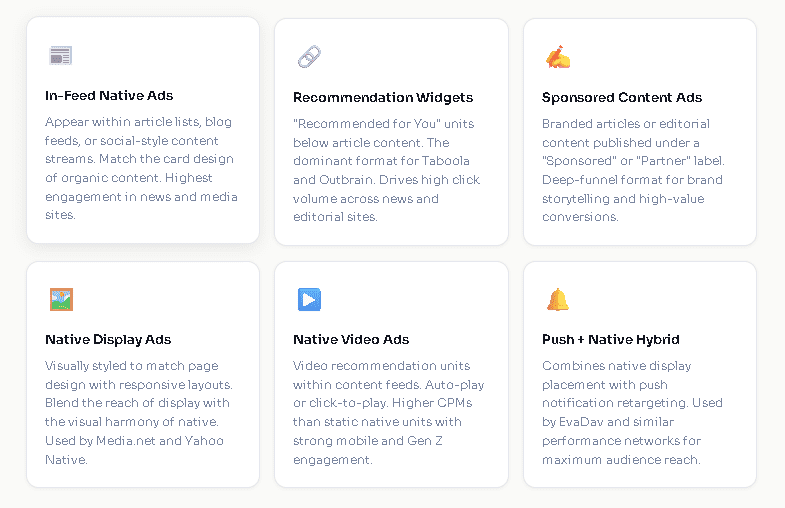
Types of Native Advertising Formats
Each native ad format serves a different publisher context and audience behavior. Understanding these formats helps you select the right network for your site structure.
Why Native Advertising Is Growing in 2027
The native advertising market is projected to surpass $100 billion globally in 2026, driven by the collapse of third-party cookies, the mobile-first shift, and the relentless rise of banner blindness. Here are the forces powering growth:
Banner Blindness Has Reached Critical Levels
Studies consistently show that users consciously and unconsciously ignore display ad zones, a phenomenon that worsens year over year. Average CTR on standard banner ads has fallen below 0.1% globally. Native ads achieve 3–8× higher CTRs because they do not announce themselves as ads; they invite engagement as content.
Mobile-First Browsing Behavior
Over 65% of global web traffic now originates from mobile devices, where banner ads are especially disruptive. Native formats, particularly in-feed units and content recommendation widgets, fit naturally into the infinite-scroll mobile experience without interrupting the user journey.
AI-Powered Contextual Targeting
As third-party cookies phase out, contextual targeting is resurgent and native ad networks are its primary beneficiaries. Modern platforms use large language models and semantic understanding to match ads to content intent, not just keyword proximity. This makes native ads effective even in fully cookieless environments.
Programmatic Native Advertising Maturity
The integration of programmatic native advertising with major DSPs (demand-side platforms) has unlocked institutional advertiser budgets for native inventory. Networks like TripleLift, Sharethrough, and Outbrain now offer full OpenRTB-compliant programmatic native, giving publishers access to premium CPMs from Fortune 500 advertisers.
12+ Best Native Ad Networks for Publishers in 2027
Each platform was evaluated on publisher monetization potential, approval accessibility, CPM competitiveness, ad format variety, payment reliability, and quality of advertiser demand.
- Taboola
- Outbrain
- MGID
- Revcontent
- Yahoo Advertising
- EvaDav
- Adsterra
- Media.net
- TripleLift
- Sharethrough
- BidVertiser
- Content.ad
- Dianomi
Since there are many Native Ad Networks in the online market, it is difficult to choose the one that is good for us. Some ad networks also accept small publishers.
1. Taboola
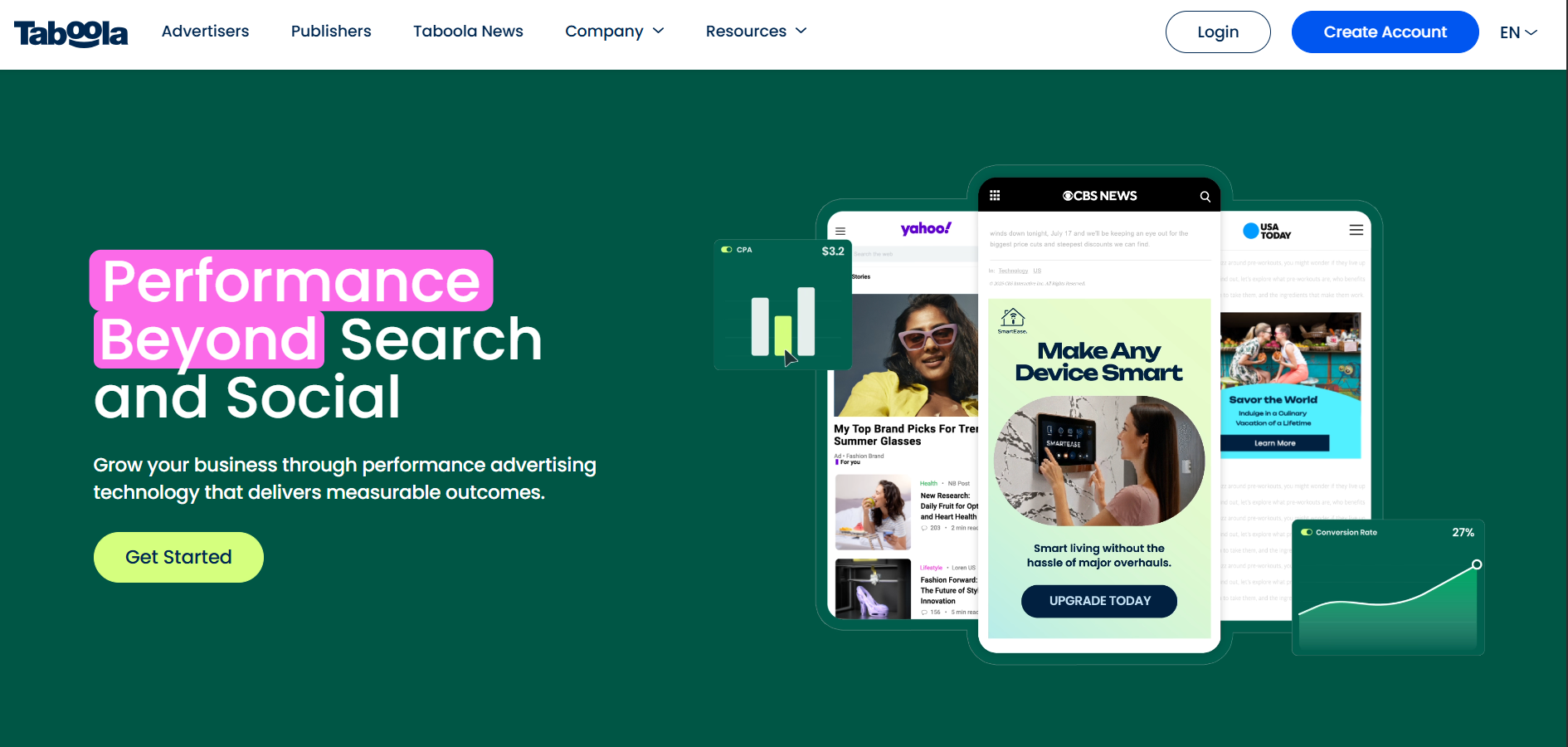
Taboola is the world’s largest content discovery and native advertising platform, powering recommendation widgets on over 9,000 premium publishers, including NBC News, USA Today, The Independent, and Bloomberg. Its “Around the Web” and “You May Also Like” widgets are the most recognizable native ad format globally. For publishers meeting their traffic threshold, Taboola delivers unmatched advertiser demand and consistently high CPMs for US, UK, and Australian audiences.
Key Publisher Features
- Recommendation widgets below and within article content
- Sponsored content and in-feed native units
- Real-time bidding from 15,000+ global advertisers
- Taboola News integration for mobile news aggregators
- A/B testing tools for placement optimization
- Dedicated publisher success managers
Pros
- Highest advertiser demand volume
- Excellent US/UK CPMs
- Premium publisher roster
Cons
- High minimum traffic requirement
- Long approval process
- Net-45 payment delay
2. Outbrain
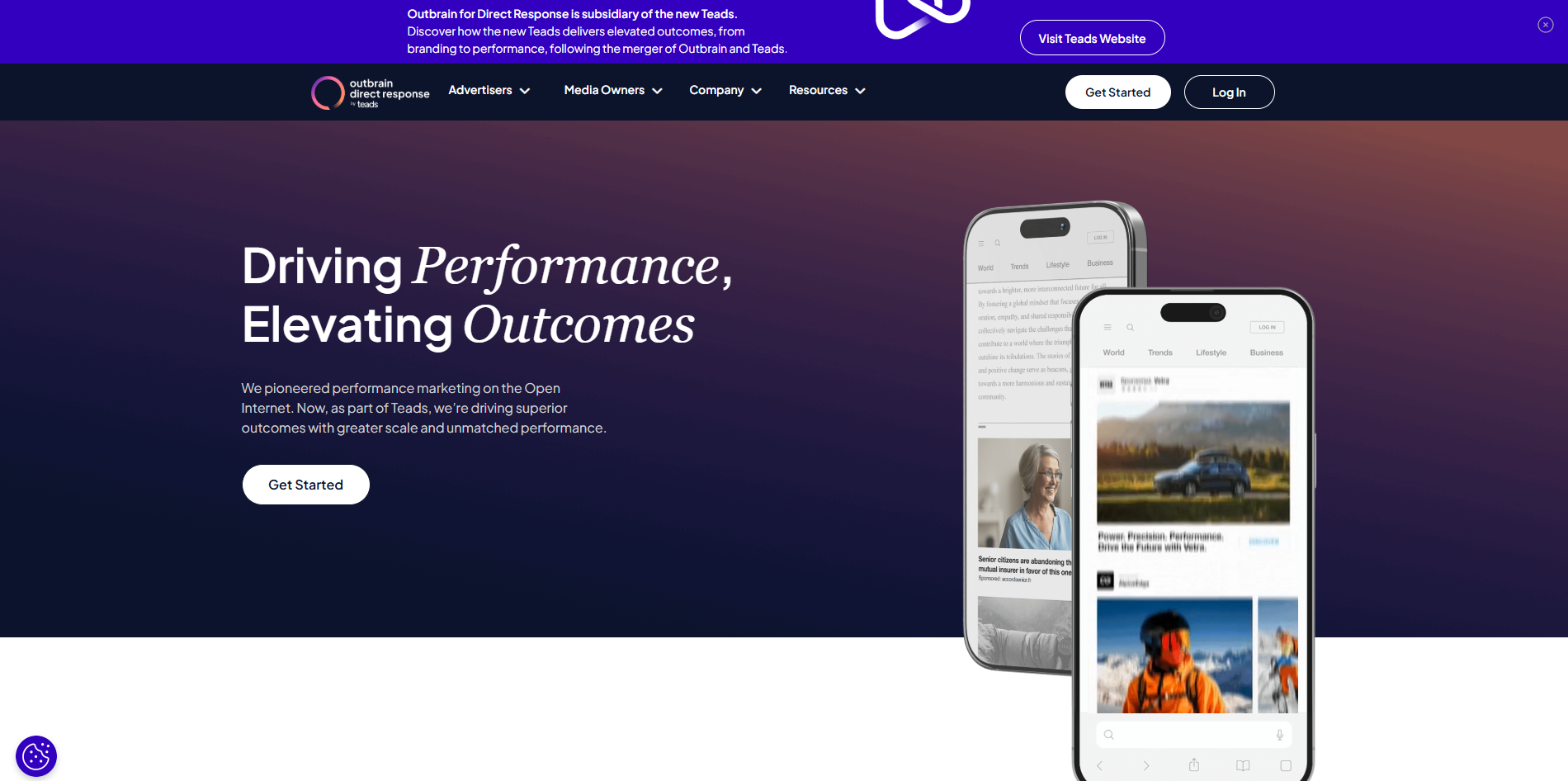
Outbrain is Taboola’s closest competitor and powers native recommendation widgets on some of the world’s most respected editorial sites, CNN, Le Monde, Sky News, and The Guardian. Its SmartFeed™ technology blends editorial recommendations with paid content in a single personalized widget, maximizing both user engagement and publisher yield. Outbrain places strong emphasis on content quality and brand safety, making it the preferred choice for publishers with premium editorial standards.
Key Publisher Features
- SmartFeed™ editorial + paid content integration
- Outbrain Keystone publisher platform
- First-party audience data monetization
- Native video recommendation units
- Direct deal marketplace for premium campaigns
- Attention-based optimization engine
Pros
- Premium publisher positioning
- Excellent European CPMs
- High editorial content standards
Cons
- Very high traffic threshold
- Net-60 payment terms
- Selective approval process
3. MGID
MGID is one of the most accessible premium native advertising networks, welcoming publishers with as few as 3,000 monthly unique visitors. It operates a global native advertising marketplace with strong demand across Tier-2 and Tier-3 GEOs — particularly Southeast Asia, Latin America, Eastern Europe, and Africa — making it uniquely valuable for publishers with international traffic that Taboola and Outbrain undervalue. Its AI-powered personalization engine optimizes content recommendations for individual user behavior.
Key Publisher Features
- In-content and widget native ad placements
- Multilingual ad support (40+ languages)
- AI-powered content recommendation engine
- Real-time revenue analytics dashboard
- Anti-bot traffic filtering (ClickProtect™)
- Dedicated account managers
Pros
- Low traffic threshold
- Strong global GEO coverage
- Fast approval (24–48 hrs)
Cons
- Lower CPMs for non-US traffic
- Ad quality varies by region
- $100 minimum payout
4. Revcontent
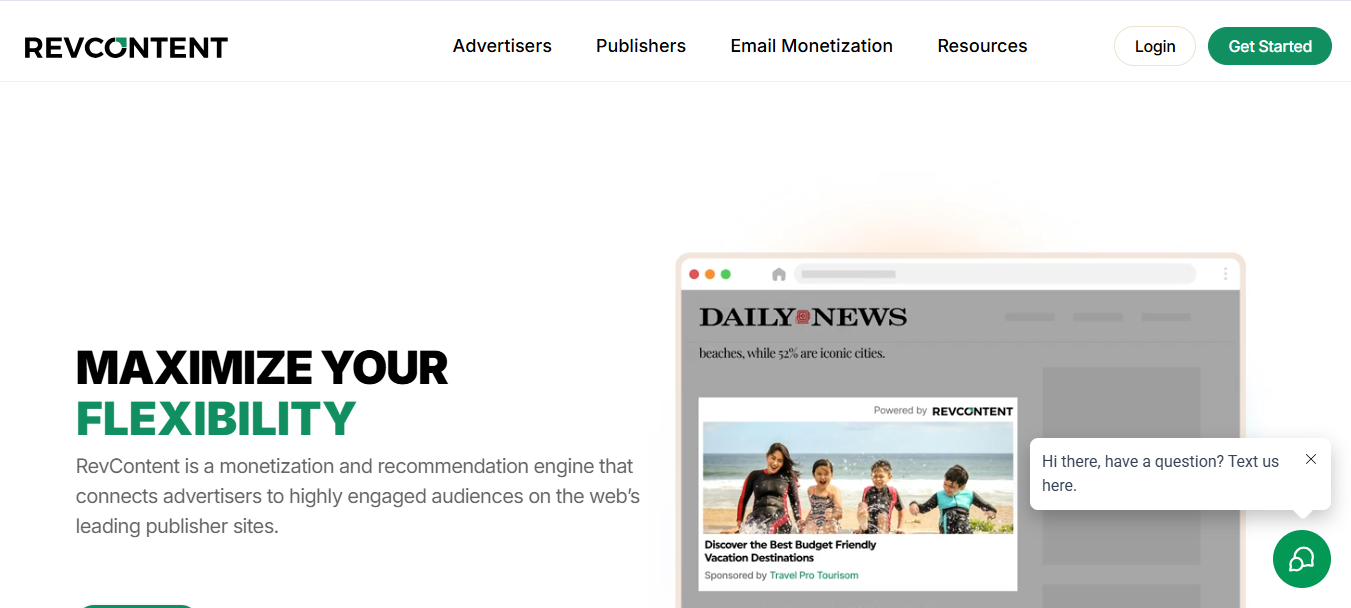
Revcontent positions itself as a quality-focused alternative to Taboola and Outbrain, with a selective publisher approval process designed to maintain high advertiser CPMs. It powers native content discovery for major US publishers and is known for industry-leading widget customization. Publishers can precisely control the visual design, number of recommendations, and content mix. Its “Boost” feature enables publishers to recirculate their own content alongside paid recommendations, driving audience retention and revenue.
Key Publisher Features
- Fully customizable native widget design
- Boost™ internal content recirculation
- Infinite scroll and in-feed native placements
- Real-time performance dashboard
- Direct publisher-advertiser campaign deals
- Publisher API for custom integrations
Pros
- High widget customizability
- Strong US/CA CPMs
- Built-in content recirculation
Cons
- Strict content quality review
- Lower international demand
- Slower approval process
5. Yahoo Native (Yahoo DSP)
Yahoo Advertising (formerly Verizon Media) combines premium owned-and-operated inventory across Yahoo Finance, Yahoo News, TechCrunch, and Yahoo Sports with a programmatic marketplace that supports robust native ad formats. For enterprise publishers, the Yahoo Native platform unlocks Fortune 500 brand budgets combined with Yahoo’s rich first-party email and behavioral data, resulting in competitive CPMs, particularly for finance, tech, and news content.
Key Publisher Features
- Gemini Native in-feed ad units
- Native display with dynamic creative
- ConnectID cookieless identity solution
- Yahoo first-party audience data integration
- Contextual + behavioral native targeting
- Real-time bidding from premium demand partners
Pros
- Premium brand advertiser demand
- Strong first-party data advantage
- Finance/tech niche strength
Cons
- High entry barrier for smaller publishers
- $500 payout minimum
- Complex platform interface
6. EvaDav
EvaDav is a performance-first advertising network specializing in the combination of push notification and native ad monetization, a powerful hybrid for publishers looking to maximize revenue per user session. It offers native banner units alongside push subscriber collection, creating a two-channel monetization approach that outperforms either format in isolation. Weekly payments and low minimum thresholds make it attractive for growing publishers.
Key Publisher Features
- Native banner ad placements (in-article, in-feed)
- Push notification subscriber monetization
- In-page push native hybrid format
- Weekly payment schedule
- Anti-fraud protection system
- Simple single-tag integration
Pros
- Dual revenue stream (native + push)
- Weekly payments
- Very low payout minimum
Cons
- Lower premium GEO CPMs
- Push format can reduce UX quality
- Less brand-safe for premium sites
6. Adsterra Native Ads
Adsterra is a performance-focused ad network supporting native ads alongside display, push, and interstitial formats, making it an excellent all-in-one monetization solution for small and mid-sized publishers who want flexibility. With no minimum traffic requirement and approval typically within 10 minutes, it’s the fastest network for publishers looking to monetize from day one. Its Partner Care program provides dedicated support even for low-traffic publishers.
Key Publisher Features
- Native banner ad units (in-article, in-feed)
- Multi-format monetization: native + push + display
- No minimum traffic requirement
- Bi-weekly payments with a $5 minimum
- Anti-AdBlock technology
- Direct advertiser deals marketplace
Pros
- Zero traffic requirement
- Lowest payout minimum ($5)
- Fastest approval process
Cons
- Lower CPMs for premium GEOs
- Ad quality can vary
- Less brand-safe than premium networks
7. Media.net
Media.net is the exclusive provider of the Yahoo! Bing Network contextual ads program — giving publishers access to contextual native advertising demand from Microsoft and Yahoo’s combined advertiser ecosystem. This makes it particularly powerful for English-language content sites targeting US, UK, and Canadian audiences. Its native ads blend seamlessly with content through responsive display-native hybrid units, and its contextual matching is among the most sophisticated in the industry.
Key Publisher Features
- Yahoo/Bing contextual native demand
- Responsive in-content and display-native units
- Header bidding integration
- Dedicated account management
- Dynamic ad sizing for mobile
- Real-time RPM optimization
Pros
- Excellent English content monetization
- Strong Yahoo/Bing demand
- Great contextual relevance
Cons
- Underperforms for non-English content
- Less effective for Tier-2/3 GEOs
- Primarily English traffic focus
8. TripleLift
TripleLift is the premier programmatic native advertising exchange, connecting premium publishers to thousands of advertisers through OpenRTB-compliant real-time bidding. Its computer vision technology automatically extracts imagery from advertiser creative and assembles native ad units that match each publisher’s unique design aesthetic, with no manual creative production required. Integration with all major header bidding wrappers (Prebid.js) makes it a natural addition to any sophisticated publisher tech stack.
Key Publisher Features
- OpenRTB programmatic native exchange
- Computer vision-based automatic creative assembly
- Full Prebid.js header bidding integration
- Native in-feed, in-article, and in-app units
- Brand safety powered by DoubleVerify
- CTV and commerce native formats
Pros
- True programmatic native scale
- No manual creative required
- Best-in-class header bidding
Cons
- Complex setup for beginners
- Requires existing tech infrastructure
- Net-60 payment terms
9. Sharethrough
Sharethrough operates one of the world’s largest independent native advertising exchanges, serving in-feed native units across a premium publisher network with a strong emphasis on attention measurement and sustainable advertising. Its Green Media℠ program is the industry’s first carbon-neutral ad serving initiative, increasingly important for ESG-focused brand advertisers whose sustainability mandates now flow through their media buying. Sharethrough’s SHX platform integrates directly with Prebid for seamless header bidding.
Key Publisher Features
- In-feed native ad exchange with premium demand
- Green Media℠ carbon-neutral ad serving
- MOAT-verified attention measurement
- SHX Prebid adapter for header bidding
- Native video recommendation units
- Dynamic layout engine for design matching
Pros
- Strong attention metrics reporting
- ESG brand advertiser appeal
- No minimum traffic barrier
Cons
- Lower CPMs than Taboola/Outbrain
- Less known to smaller publishers
- Best value at scale
10. BidVertiser
BidVertiser is a veteran ad network that has served small publishers since 2008, offering a no-frills, accessible monetization solution with native ads, display, and popunders. With no minimum traffic requirements, an extremely low $10 payout threshold, and acceptance of most content types, it remains a go-to starting point for brand-new publishers building their first monetization stack. Revenue expectations are modest, but the reliability and speed of approval make it a useful beginner tool.
Key Publisher Features
- Native slider and in-feed ad units
- XML feed monetization for search traffic
- Low $10 payout minimum
- Daily payment option available
- Multiple ad format support
- Simple publisher dashboard
Pros
- $10 minimum payout
- Daily payment available
- Accepts all traffic levels
Cons
- Very low CPMs
- Dated platform interface
- Limited native format variety
11. Content.ad

Content.ad is a curated native advertising network focused on content quality over volume. It rigorously screens both publishers and advertisers, resulting in better-than-average CTRs for its recommendation widgets. For smaller content publishers (blogs, niche media sites, hobby communities) that don’t qualify for Taboola or Outbrain, Content.ad offers a credible alternative with a minimum of just 10,000 monthly pageviews and responsive customer support.
Key Publisher Features
- Customizable recommendation widget designs
- Curated advertiser quality screening
- In-article native ad placements
- Responsive mobile-first widget rendering
- Publisher earnings dashboard
- US-based publisher support team
Pros
- Quality ad screening
- Accessible to small publishers
- Strong US support
Cons
- Limited global advertiser pool
- Lower CPMs than premium networks
- Less sophisticated targeting
12. Dianomi
Dianomi is a niche-specialized native advertising platform serving exclusively financial services, investment, and business content. Publishers in the finance vertical can achieve CPMs of $5–$15+ through Dianomi because its advertiser base consists of banks, asset managers, insurance firms, and fintech companies with some of the highest advertising budgets in any industry. Used by Financial Times, Reuters, Bloomberg affiliates, and major financial news sites globally.
Key Publisher Features
- Finance-vertical native ad marketplace
- Premium financial advertiser direct access
- Sponsored investment content distribution
- Brand-safe editorial contextual targeting
- Publisher analytics with CPM benchmarking
- Compliant with financial advertising regulations
Pros
- Highest CPMs in the finance niche
- Premium financial advertiser access
- Regulatory-compliant formats
Cons
- Finance/business content only
- Not suitable for general publishers
- Application requires a niche match
Comparison Table: All 15 Native Ad Networks
Use this comparison table to quickly match each native advertising platform to your traffic level, GEO, and payment preferences.
| Network | Best For | Min. Traffic | CPM Range (US) | Payment Terms Best | t GEO |
|---|---|---|---|---|---|
| Taboola | Large publishers | 500K PV/mo | $2–$8 | Net-45 | US, UK, AU, CA |
| Outbrain | Premium editorial publishers | ~1M PV/mo | $1.50–$7 | Net-60 | US, UK, EU |
| MGID | Mid-sized / global publishers | 3,000 uniques | $0.10–$3 | Net-30 | Global, SEA |
| Revcontent | High-engagement US sites | 50K PV/mo | $1.50–$6 | Net-30 | US, CA, AU |
| Yahoo Advertising | Enterprise publishers | Enterprise-level | $1–$6 | Net-30 | US, UK, CA |
| EvaDav | Push + native hybrid monetization | None | $0.01–$1.50 | Weekly | Global, Tier-2 |
| Adsterra | Small/mixed traffic publishers | None | $0.05–$2 | Bi-weekly | Global |
| Media.net | English contextual publishers | None formal | $1–$5 | Net-30 | US, UK, CA |
| TripleLift | Programmatic native monetization | Via header bidding | $1–$8 | Net-60 | US, UK, AU |
| Sharethrough | Omnichannel native advertising | None | $0.80–$5 | Net-45 | US, UK, CA |
| BidVertiser | Beginner publishers | None | $0.01–$0.80 | Daily | Global |
| Content.ad | Small content sites | 10K PV/mo | $0.30–$2 | Net-30 | US, UK |
| Dianomi | Finance publishers | Finance niche | $5–$15+ | Net-30 | US, UK, AU |
Best Native Ad Networks for Small Publishers
If your website receives under 50,000 monthly pageviews, the premium networks like Taboola and Outbrain are out of reach. But that does not mean you cannot effectively monetize with native advertising. These four networks are the best starting points for small publishers:
- Adsterra Native: Zero traffic requirement, $5 payout minimum, instant approval, the fastest path to native monetization for any site size.
- MGID: Accepts sites with 3,000+ monthly unique visitors and strong global GEO coverage, making it ideal for non-US traffic.
- Content.ad: Accepts sites with 10,000+ monthly pageviews, with better ad quality than most entry-level networks.
- BidVertiser: No minimums, $10 payout threshold, and daily payment option best for brand-new publishers building initial revenue.
Common Mistakes Publishers Make With Native Ads
Excessive Widget Stacking
Placing 3–5 native widgets on a single page crushes CPM rates and signals poor editorial quality to premium advertisers.
Misleading Headlines
Allowing clickbait headline creatives through your widget damages audience trust and violates network quality standards, risking account suspension.
Ignoring Page Speed Impact
Multiple synchronous native ad scripts can add 500ms+ to page load times, directly hurting Core Web Vitals rankings and organic search traffic.
No Ad Disclosure Labels
Failing to display FTC-required “Sponsored” labels on native content is a compliance violation that can result in account termination and fines.
Choosing Only One Network
Running a single native ad network leaves significant revenue on the table. Header bidding with 2–3 native partners increases yield by 20–35%.
Ignoring GEO Performance
Using a US-focused network like Taboola for primarily non-US traffic leaves 60–80% of your potential revenue unrealized. Match networks to your GEO profile.
Programmatic Native Advertising Explained
Programmatic native advertising applies automated, real-time bidding (RTB) technology to native ad formats, enabling advertisers to buy native impressions through DSPs (demand-side platforms) and publishers to sell them through SSPs (supply-side platforms), all in milliseconds.
The IAB’s OpenRTB Native specification standardizes how native ad signals (headline, image, description, brand name, CTA) are passed between buyers and sellers, allowing demand from thousands of advertisers to compete for each native impression on a publisher’s page in real time.
How Programmatic Native Works for Publishers
- Publisher integrates a header bidding adapter (e.g., Prebid.js with TripleLift or Sharethrough adapter)
- When a page loads, the header bidding wrapper sends a bid request to all connected DSPs simultaneously
- DSPs evaluate the user, page context, and bid price, then submit bids in under 100ms
- The highest bid wins; the winning native creative is assembled and rendered on the page
- Publisher receives the winning CPM minus the SSP/network fee (typically 20–40%)
Key Benefit: Programmatic native removes the need for direct sales relationships. Publishers can access thousands of global advertisers simultaneously through platforms like TripleLift, Sharethrough, and Google’s native exchange without a dedicated sales team.
Conclusion
Native advertising is the most publisher-friendly monetization channel in digital media today, with high engagement, low disruption, and growing advertiser budgets. Start with networks matched to your current traffic level, expand to programmatic native as you scale, and always stack multiple demand sources through header bidding to maximize yield. The publishers earning the most from native ads in 2026 are those treating their ad stack as a competitive advantage, not an afterthought.
By leveraging these networks, publishers can diversify ad revenue streams, optimise sponsored content placements, and track performance with real-time analytics dashboards. Whether you run a news website, blog, or content-rich portal, selecting a trusted native advertising platform ensures better monetisation, higher engagement, and consistent payouts. Start exploring these networks today to boost your website revenue with native advertising in 2027.
Frequently Asked Questions (FAQs)
Q1. What are Native Ad Networks & How is it different from regular ad networks
A native ad network is a platform that connects publishers with advertisers specifically to deliver ads designed to blend with the surrounding content in appearance, format, and editorial style. Unlike standard ad networks that serve rectangular banner units in fixed page zones (header, sidebar, footer), native ad networks deliver ads that appear within the content flow as recommendation widgets, in-feed cards, sponsored articles, or contextual content units.
Q2. Which native ad network pays the highest CPM in 2027?
For US and UK audiences, Taboola and Outbrain consistently deliver the highest native ad CPMs, ranging from $2 to $8 per thousand impressions for quality English-language content. If your site covers finance, investment, or business topics, Dianomi is in a league of its own with CPMs reaching $5 to $15 or more because financial advertisers carry some of the biggest ad budgets in the industry. Nativo’s branded content campaigns can go even higher, often paying $5 to $30 CPM for sponsored article placements on premium editorial sites.
Q3. Can I join a native ad network if my website is brand new with low traffic?
Absolutely, several native ad networks have zero minimum traffic requirements and approve new publishers within minutes. Adsterra is the most beginner-friendly, accepting any site with a $5 payout minimum and bi-weekly payments, while BidVertiser offers daily payment options with a $10 minimum threshold. Once your site grows to around 3,000 monthly unique visitors, MGID becomes available, and at 10,000 monthly pageviews, you can apply to Content.ad both significantly better monetization options than pure beginner networks.
Q4. What is the difference between native ads and display ads for publishers?
The core difference is integration: display ads sit in fixed banner slots that users have trained themselves to ignore, while native ads are designed to look and feel like editorial content, making them far less likely to trigger banner blindness. Native ads generate 3 to 8 times higher CTRs than standard display banners, perform significantly better on mobile devices, and are more resistant to ad blockers because they load as content rather than recognizable ad units. For most content publishers, native ads deliver better engagement and steadily growing CPMs, while display ads still hold value for above-the-fold programmatic placements.
Q5. How much money can a publisher realistically make from native advertising?
Earnings vary enormously based on your traffic volume, GEO breakdown, content niche, and which network you use. A US-based finance site with 500,000 monthly pageviews can earn $1,000 to $4,000 per month from a single Taboola or Dianomi widget, while a general lifestyle blog with global traffic might earn $50 to $300 per month from MGID. The most important levers are your audience’s country (US traffic earns 10 to 20 times more than Southeast Asian traffic), your content niche (finance and health pay the most), and Q4 seasonality, when CPMs spike 30 to 50 percent above annual averages.
Q6. Is it safe to run multiple native ad networks on the same website?
Yes, and it’s actually recommended to run two or three native networks through header bidding, which lets them compete for each impression in real time, which consistently increases your total yield by 20 to 35 percent compared to using a single network. The key is to limit total ad units to one or two native widgets per page to protect page speed and user experience, and to integrate additional demand sources through a header bidding wrapper like Prebid.js rather than adding separate JavaScript tags for each network. Networks like TripleLift and Sharethrough are specifically designed for this kind of programmatic stacking.
Q7. How long does it take to get approved by a native ad network?
Approval timelines vary dramatically by network. Adsterra and BidVertiser approve publishers in as little as 10 to 30 minutes, while MGID and Content.ad typically take 24 to 48 hours. Premium networks like Taboola, Outbrain, and Nativo can take anywhere from one to four weeks because they manually review site quality, traffic authenticity, and content standards before acceptance. To maximize your approval chances at any network, ensure your site has a clear privacy policy, original content, consistent traffic history, and no policy-violating niches like illegal content, excessive pop-ups, or auto-generated articles before applying.
Q9. Do native ads slow down my website and hurt my Google rankings?
Native ad scripts can add meaningful load time if implemented carelessly. A synchronous third-party JavaScript tag loading carelessly before your main content can add 300 to 600 milliseconds to page load, directly hurting your Core Web Vitals scores. The solution is lazy loading: configure your native ad widgets to initialize only after the main page content has fully loaded, which preserves your Largest Contentful Paint (LCP) and First Input Delay (FID) scores. Most major networks, including Taboola, Outbrain, and MGID, support asynchronous loading and provide AMP-compatible tags specifically for publishers who prioritize page speed.
