

Digital advertising is entering a defining era. In 2026, global ad spend is projected to surpass $700 billion, with programmatic advertising driving the majority of transactions. At the center of this ecosystem are ad networks the infrastructure that connects advertisers with publishers at scale.
What’s the fastest way to know which ad network is right for you? Your traffic volume, your content niche, and how quickly you need to get paid. This guide breaks down all three for every major network, using payment terms verified directly from official sources rather than third-hand estimates.
Despite their importance, many marketers and publishers still struggle to choose the right ad network. The result: low CPMs, poor fill rates, wasted budgets, and missed revenue opportunities.
If you’ve ever wondered:
- Why your ad revenue is inconsistent
- Which ad network actually pays the most and pays on time
- How programmatic advertising really works in 2026
This guide is designed to give you complete clarity.
Ad networks pay publishers through CPM (per 1,000 impressions), CPC (per click), or CPA (per action) models. Minimum traffic requirements range from 0 to 100,000 monthly pageviews, depending on the network. Whether you run a small blog or a high-traffic website, choosing the right ad network can be the difference between earning $50/month and $5,000/month from the same content.
What Are Ad Networks?
An ad network is a platform that connects advertisers with publishers who have available ad space, automating the buying, placement, and payment process between them. Advertisers use ad networks to reach targeted audiences across thousands of websites, while publishers use them to monetize traffic without managing individual advertiser relationships.
In simple terms:
Publishers provide ad space → Ad networks connect advertisers → Ads are displayed → Revenue is generated
Let’s understand this with a basic example:
- You create a blog and start publishing content
- You join an ad network
- The ad network places relevant ads on your website
- When users view or interact with those ads, you earn money
So essentially, an ad network simplifies the entire advertising process by automating ad placement, targeting, and payments.
How Ad Networks Work? (Step by Step)
Understanding how ad networks work is essential if you want to turn your website traffic into a consistent revenue stream. Below is a clear, step-by-step breakdown of how this ecosystem operates in practice.
1. Publisher Signup
The process begins when a publisher joins an ad network platform such as Google AdSense or Media.net. During signup, you typically need to provide:
- Website URL
- Content category (e.g., tech, health, finance)
- Traffic details
- Contact and payment information
High-quality niches like finance, SaaS, and health often get faster approvals due to strong monetization potential.
2. Website Approval
Once you submit your site, the ad network performs a detailed review a critical filtering stage to maintain quality across the network.
Key factors evaluated include:
- Content Quality: Original, valuable, and well-structured content
- Traffic Volume: Some networks require a minimum monthly number of visitors
- Policy Compliance: No prohibited content (e.g., adult, pirated, misleading claims)
- User Experience (UX): Mobile responsiveness, page speed, and navigation
If your site meets the criteria, you get approved and gain access to an ad dashboard, ad unit creation tools, and performance analytics. Premium networks may also assign an account manager for optimization support.
3. Ad Placement on Website
After approval, you receive an ad code snippet (usually JavaScript) to place where you want ads to appear header, sidebar, in-content, or footer.
Once implemented, the ad network automatically starts showing ads using technologies like:
- Contextual targeting: Ads match your content topic
- Behavioral targeting: Ads based on user browsing history
- Geo-targeting: Ads tailored to user location
A user visiting from the US may see higher-paying ads than users from lower-CPM regions. Behind the scenes, many networks use real-time bidding (RTB), where advertisers compete in milliseconds to display their ads to your visitors.
4. Earn Revenue & Get Paid
Once ads are live, you start generating revenue based on user interactions, under one of three primary models:
- CPM (Cost Per Mille): You earn per 1,000 ad impressions
- CPC (Cost Per Click): You earn when users click on ads
- CPA (Cost Per Action): You earn when users complete an action (e.g., signup, purchase) this model overlaps heavily with affiliate marketing, since the payout is tied to a completed action rather than a view or click
Your total earnings depend on traffic volume, audience location, niche demand, and ad placement quality. We break down exactly how fast each major network pays out later in this guide.
Types of Ad Networks
Advertising networks segment by inventory quality, targeting sophistication, format specialization, and business model. Below, we break down the major categories with their strategic applications.
Vertical (Niche) Networks
Vertical networks concentrate on industry-specific publishers, ensuring relevance and higher engagement. A fashion vertical, for instance, might partner exclusively with style blogs and apparel-focused publishers, delivering ads for clothing brands to genuinely interested readers.
Advantages:
- Laser-focused audiences reduce acquisition costs by 30–50%.
- Premium context boosts brand safety ads appear alongside aligned content.
- Higher CTRs (click-through rates) due to intent matching.
Disadvantages:
- Limited scale compared to horizontal options.
- Higher CPMs reflecting quality inventory.
- Requires closer content alignment off-topic placements hurt relevance and CTR.
Strategic Use: E-commerce brands use verticals for seasonal campaigns, layering lookalike audiences atop niche traffic. In automotive, vertical networks target car shoppers with dynamic, model-specific creatives.
Horizontal (General) Networks
Horizontal networks cast a wide net across diverse publishers, prioritizing volume over specificity think remnant inventory from news sites, blogs, and forums. The Google Display Network exemplifies this, reaching the vast majority of the open web.
Advantages:
- Massive reach across billions of daily impressions.
- Cost-effective for broad awareness (CPMs as low as $1–3).
- Flexible targeting via third-party data cooperatives.
Disadvantages:
- Brand safety risks from low-quality or fraudulent placements.
- Lower engagement due to mismatched contexts.
- Harder to stand out generic placements compete with thousands of other advertisers for attention.
Strategic Use: Startups leverage horizontals for top-of-funnel growth hacking, blasting awareness ads across news and entertainment sites, then retargeting converters via pixels.
Premium Networks
Premium networks curate top-tier inventory from blue-chip publishers, often via direct deals or private marketplaces (PMPs). Transparency reigns no blind buys here.
Advantages:
- Viewability scores above 70%, independently audited.
- Sequential messaging across premium environments.
- Fixed pricing avoids auction volatility.
Disadvantages:
- Steep entry barriers (minimum spend often $50K+).
- Slower scaling due to exclusive inventory.
- Less flexibility for smaller or mid-size budgets that can’t commit to minimum spend requirements.
Strategic Use: Luxury brands deploy premium networks for halo-effect campaigns, combining video mastheads with rich media. Pharma advertisers favor them for compliance-sensitive health content.
Inventory-Specific Networks
These specialize in particular ad formats or channels:
- Display Networks: Static banners and rich media
- Video Networks: In-stream and out-stream formats, often using TrueView or rewarded-video models
- Mobile/In–App Networks: Interstitials and offerwalls for gaming and utility apps
- Native Networks: Outbrain and Taboola-style ads blended into content feeds
- Push Notification Networks: Opt-in browser and mobile alerts, popular for direct-response and app-install offers
- Audio/CTV Networks: Podcasts and streaming TV placements
Advantages:
- Format-specific optimization can yield 2–5x higher engagement than generic placements.
- Mobile and in-app formats alone reach billions of global users.
- Specialized networks often have deeper technical expertise in their format (video encoding, native templates, push infrastructure).
Disadvantages:
- Platform fragmentation requires multi-network management.
- Managing several specialized networks simultaneously adds operational overhead.
- Formats like native or CTV often require creative assets tailored to each platform’s specs.
Strategic Use: Gaming companies use in-app networks for cost-per-install campaigns under $2, while streaming platforms drive CTV attribution for upper-funnel awareness
| Network Type | Primary Formats | Avg. CPM Range | Ideal Campaigns | Scale Potential |
|---|---|---|---|---|
| Vertical | Display, Native | $5-20 | Industry Targeting | Medium |
| Horizontal | Display, Video | $1-5 | Awareness | High |
| Premium | Video, Rich Media | $10-50 | Branding | Low-Medium |
| Display | Banners | $2-8 | Retargeting | High |
| Video | In/Out-Stream | $8-25 | Engagement | High |
| Mobile | Interstitials | $3-12 | App Installs | Very High |
| Native | Feeds | $4-15 | Content Discovery | High |
| CTV | Streaming Spots | $15-40 | Upper Funnel | Growing |
Targeted (Performance) Networks
Leveraging data management platforms (DMPs), these networks use psychographics, geofencing, and lookalike audiences for precision. Post-cookie, they’ve pivoted toward clean rooms and contextual AI.
Advantages:
- ROAS (return on ad spend) up to 5x via attribution modeling.
- Cross-device tracking via probabilistic ID solutions.
- Granular attribution makes it easier to prove which campaigns actually drive revenue.
Disadvantages:
- Data depreciation from third-party signal loss.
- Privacy scrutiny demands consent management.
- Performance can be harder to forecast as cookie deprecation continues reshaping targeting data.
Strategic Use: E-tailers employ these networks for dynamic pricing, bidding higher on high-lifetime-value segments.
How to Choose the Right Ad Network?
With dozens of options available, choosing the wrong ad network means leaving money on the table. Use these five factors to make the right decision for your situation.
1:Your monthly traffic volume. This is the single most important factor. Many premium networks require 50,000 to 100,000 monthly pageviews. If you’re below this threshold, start with Google AdSense, Media.net, or Ezoic all three have no minimum traffic requirement and remain popular entry points for bloggers and new publishers alike.
2: Your content niche. Finance, crypto, and technology content attracts advertisers who pay significantly more per impression than general lifestyle content. If your niche is high-value, seek out niche-specific networks; the CPM difference can be 3 to 10 times higher.
3: Your preferred payment model. High-traffic sites with lower engagement benefit from CPM networks. Smaller sites with highly engaged, click-happy audiences benefit more from CPC networks. Test both if you’re unsure.
4: Minimum payout threshold. Thresholds range from $20 (Ezoic) to $200 (PubMatic) across the networks covered in this guide. If your site earns slowly, a lower threshold means you get paid sooner and more predictably.
5: Geographic reach of your audience. Advertisers pay far more for US, UK, Canadian, and Australian traffic than for traffic from developing markets. If most of your visitors are from South Asia or Southeast Asia, look for networks that specifically serve those regions well rather than US-focused premium networks that will show low-value ads to your audience.
Which Ad Network Pays Publishers the Fastest in 2026?
Ezoic and Google AdSense pay the fastest among major networks, both running on a roughly 30-day cycle, while Amazon Publisher Services (60 days) and PubMatic (up to 90 days) take considerably longer to release earnings. Based on the payment terms each network publishes officially, here’s how payout speed compares:
- Ezoic fastest, most flexible: Net-30 by default, with a $20 minimum threshold. Publishers can opt into Net-60 or Net-90 in exchange for a 1.5%–2.25% payout bonus.
- Google AdSense fast, fixed schedule: Monthly cycle, paid between the 21st and 26th, provided the balance clears the account’s payment threshold (commonly $100) by the 20th.
- Media.net standard Net-30: Payments release 30 days after the earnings month closes, once the $100 minimum is met.
- Raptive Net-45, but guaranteed: Publishers are paid on the 15th of each month on a Net-45 schedule notably faster than the Net-60/Net-90 terms Raptive itself receives from advertiser partners and payments are guaranteed even if an advertiser fails to pay.
- Amazon Publisher Services Net-60: APS consolidates every demand source into a single payment released 60 days after each month closes.
- PubMatic slowest, Net-90 by default: As a supply-side platform built for enterprise publishers, PubMatic’s standard agreement sets payment at 90 days after each calendar month unless a shorter term is negotiated.
If consistent, faster cash flow matters more to you than chasing the highest possible CPM, a low-threshold network like Ezoic is worth weighing against a premium network’s higher rates but slower payout cycle.
Best Ad Networks for Advertisers and Publishers (2026)
Advertisers need platforms that offer precision targeting, scalable inventory, and strong ROI tracking. Below are the most effective options dominating the US, UK, and global markets each with advantages, disadvantages, payment details verified from official sources, and who it’s best suited for.
1. Google Ad Manager

Google Ad Manager remains the most powerful ad platform due to its massive inventory access and AI-driven bidding systems. It’s worth noting that Google Ad Manager functions primarily as an ad server and yield-management layer actual publisher payment flows through the demand sources connected to it, most commonly Google AdSense and Ad Exchange.
Payment Details:
- Payout: Threshold varies by currency
- Methods: EFT, check, PayPal Hyperwallet
- Frequency: Monthly
Pros:
- Access to millions of websites and apps.
- Advanced audience targeting using first-party data.
- Real-time bidding (RTB) with machine learning optimization.
Cons:
- Complex interface for beginners.
- High competition can increase costs.
- Payment doesn’t come from Google Ad Manager directly earnings depend entirely on which connected demand source (like AdSense) is actually paying you.
Best for: Large-scale campaigns and enterprise advertisers, or publishers already running AdSense who want to layer in additional PPC demand sources through header bidding.
2. Media.net
Media.net is a leading contextual advertising network the second-largest in the space after Google AdSense powering ad demand from the Yahoo and Bing advertiser network. Instead of matching ads to broad demographics, it reads the actual content of a page and serves highly relevant, contextual ads, which tends to drive stronger click-through rates for publishers with quality, English-language content.
Publishers who join gain access to premium advertiser demand along with a dedicated account manager, real-time reporting, and support for multiple ad formats including display, native, and contextual units. It’s a strong AdSense alternative for established sites with steady traffic, particularly in tier-1 markets like the US, UK, and Canada.
Payment Details:
- Minimum payout: $100
- Payment methods: Payoneer or wire transfer
- Frequency: Monthly, on Net-30 terms
- Currency: USD only
Pros:
- High-performing contextual ads.
- Strong CPC rates in the US and UK.
- Premium publisher partnerships.
Cons:
- Limited reach compared to Google.
- Requires quality content for approval.
- No longer supports PayPal publishers must use wire transfer or Payoneer.
Best for: Contextual advertising and high-quality traffic, particularly Tier-1 audiences.
3. Amazon Publisher Services
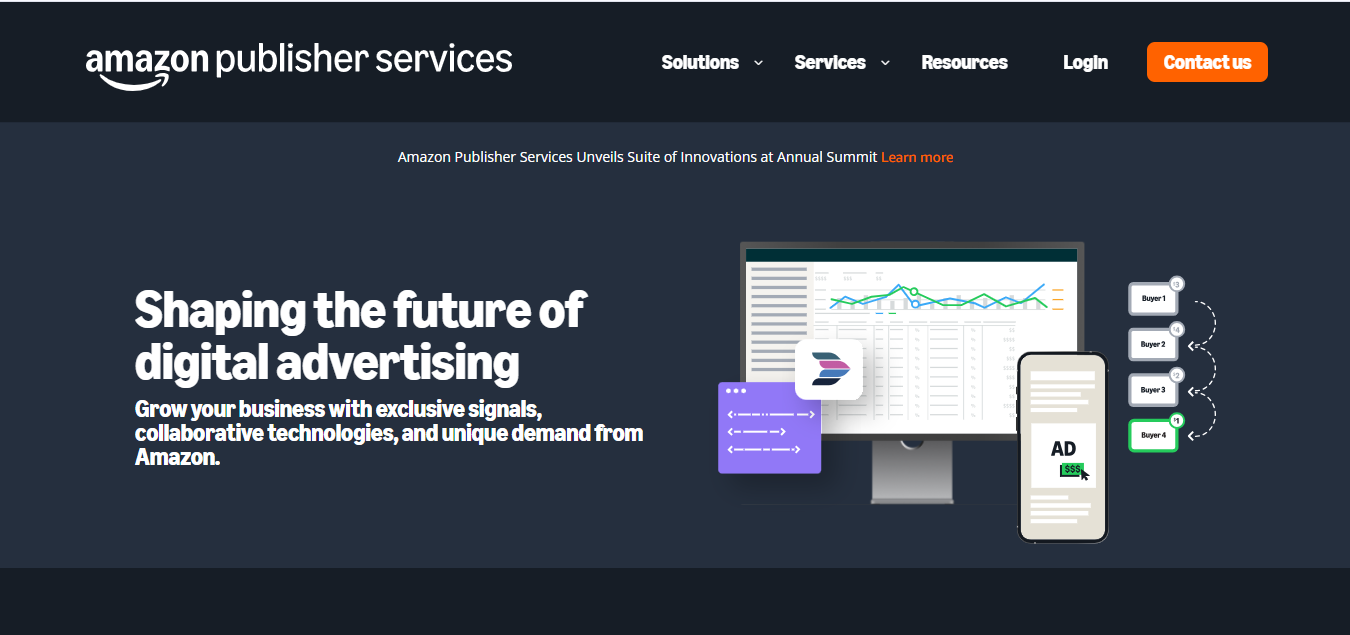
Amazon Publisher Services (APS) is a suite of cloud-based tools that help web and app publishers grow and monetize their digital ad inventory through Amazon’s programmatic advertising infrastructure. Rather than a single ad network, APS bundles several products including the Transparent Ad Marketplace (TAM) for large, enterprise publishers and the Unified Ad Marketplace (UAM) for small to mid-sized publishers all accessible through one cloud-based header bidding integration.
The core appeal is competitive, transparent bidding: Amazon Ads and third-party buyers compete in a unified, first-price auction where the highest bid always wins, giving publishers access to more than 50 demand sources without needing individual relationships with each supply-side platform (SSP). This makes APS a strong complement to existing programmatic setups for publishers looking to increase bid density and overall yield.
Payment Details:
- Payout: 100% of winning bid, minus 10% fee
- Frequency: Net-60
- Currency: Per publisher’s account setup
Pros:
- Access to buyer intent data.
- High conversion rates.
- Integration with the retail ecosystem.
Cons:
- Best suited for e-commerce brands.
- Limited for general awareness campaigns.
- Not open to everyone smaller or mid-size publishers typically need a personal invitation from Amazon to access APS.
Best for: E-commerce advertisers and product-based campaigns.
4. Ezoic
Ezoic is an AI-driven website monetization and testing platform that automatically optimizes ad placement, size, and network selection to increase publisher revenue rather than functioning as a single ad network itself. As a Google Certified Publishing Partner, it connects publisher inventory to over 100 demand partners and uses machine learning to test which combination of ads performs best for each individual visitor, based on factors like device and location.
Ezoic is especially known for accepting smaller publishers through its Access Now program, which removed the platform’s earlier 10,000-monthly-visit requirement, making it accessible to newer sites that larger premium networks typically reject.
Payment Details:
- Minimum payout: $20
- Methods: PayPal, Payoneer, Wise, check
- Frequency: Net-30 (Net-60/90 optional, with bonus)
Pros:
- Access to buyer intent data.
- High conversion rates.
- Integration with the retail ecosystem.
Cons:
- Best suited for e-commerce brands.
- Limited for general awareness campaigns.
- Not open to everyone smaller or mid-size publishers typically need a personal invitation from Amazon to access APS.
Best for: E-commerce advertisers and product-based campaigns.
5. Raptive (Formerly AdThrive)
Raptive is one of the most trusted premium ad networks, known for delivering industry-leading RPMs and access to top-tier brand advertisers. The 2023 rebrand from AdThrive reflects its broader positioning as a full-scale creator monetization platform, not just an ad network.
Payment Details:
- Payout: $25 min ($100 for wire)
- Methods: ACH, PayPal, eCheck, Wire, Check
- Frequency: Net-45 (15th of each month)
Pros:
- Premium advertiser demand (higher CPMs than most networks).
- Dedicated account management and support.
- Strong focus on creator-first monetization strategies.
- Payments are guaranteed even if Raptive hasn’t yet collected from the advertiser.
Cons:
- Not beginner-friendly.
- Strict approval process.
- Best suited for established content sites with consistent, verified traffic.
Best for: High-traffic premium publishers with an established content library.
6. PubMatic
PubMatic is a publicly traded, cloud-based programmatic advertising platform that connects publishers with demand partners through real-time bidding (RTB), header bidding, and its OpenWrap header-bidding wrapper. Rather than a simple ad network, PubMatic operates as a sell-side infrastructure layer, processing billions of ad impressions daily and using machine-learning-driven auction technology to help publishers maximize yield across display, video, and connected TV (CTV) inventory.
The platform is built for established, higher-volume publishers rather than small blogs it emphasizes auction transparency and supply-path optimization, giving publishers visibility into how buyers are bidding on their inventory rather than operating as a black box.
Payment Details:
- Minimum payout: $200
- Frequency: Net-90 (default)
- Payment: Net of platform + auction/transaction fees
Pros:
- Advanced header bidding technology.
- Global advertiser demand.
- Strong analytics and reporting.
Cons:
- Requires technical setup.
- Better suited for experienced publishers.
- Publisher payout requires reaching a $200 aggregate minimum before funds are released.
Best for: Programmatic monetization and header bidding at scale, typically for larger, more technical publishing teams.
Ad Networks vs Affiliate Networks: What is the Difference?
Publishers often confuse ad networks with affiliate networks, but they serve fundamentally different purposes.
An ad network pays you based on impressions or clicks passive income that requires no action from your visitor beyond seeing or clicking an ad. Push notification ad networks blur this line slightly: they typically pay per click like a traditional ad network, but are frequently used by advertisers to drive CPA-style offers underneath.
An affiliate network pays you a commission only when your visitor takes a specific action makes a purchase, signs up, or submits their details. The commission per action is much higher than per click, but requires the right audience and offer to convert.
The most profitable publishers use both simultaneously. Ad networks monetize visitors who are browsing passively; affiliate networks monetize visitors with purchase intent. For a detailed comparison of both models, see Digital Marketing vs Affiliate Marketing: What’s Better for Beginners? and for affiliate network options specifically, explore our Complete Guide to Affiliate Networks 2026.
How to Get Approved by Ad Networks?
Getting rejected by an ad network can slow down your monetization strategy, but most rejection reasons are predictable and fixable with the right preparation.
In 2026, ad networks have become more selective, prioritizing high-quality publishers, user experience, and policy compliance. The most common rejection factors include:
- Thin or insufficient content: (typically fewer than 20–30 high-quality, original articles)
- Low or inconsistent traffic: (many networks expect at least 300+ daily visitors)
- Policy violations: (including copyrighted material, adult content, or misleading claims)
- Poor website experience: (slow loading speed, broken links, non-responsive design)
- Geographic limitations: (premium networks often prioritize traffic from Tier-1 countries)
To increase your approval rate, focus on building a content-rich, technically optimized, and trustworthy website. This includes publishing in-depth articles, improving Core Web Vitals, and ensuring compliance with each network’s specific policies.
How AI is Changing Ad Networks in 2026?
Artificial intelligence is reshaping the digital advertising ecosystem at a foundational level. Modern ad networks no longer rely on static rules they now use advanced machine learning models to automate and optimize every stage of the ad delivery process.
AI-powered bidding systems analyze real-time data signals, including user intent, browsing behavior, device type, and contextual relevance, to determine the optimal ad price within milliseconds. This has significantly improved ad targeting accuracy and revenue efficiency.
For publishers, this shift introduces both opportunities and challenges:
- Dynamic CPM rates: Earnings can fluctuate significantly based on demand, audience quality, and seasonality
- Smarter ad matching: Ads are now personalized using behavioral and contextual data instead of basic demographics
- Revenue volatility: The same page may generate different revenue on different days due to algorithmic optimization
To stay competitive, publishers must adapt by focusing on high-intent traffic, niche authority, and content quality rather than relying solely on pageviews.
Final Thoughts
Frequently Asked Questions (FAQs)
What is the best ad network for beginners in 2026?
Google AdSense and Media.net are the best starting points for beginners;r s they have no minimum traffic requirement, accept publishers from most countries, and integrate easily with any website platform. Ezoic is the best next step once you reach 10,000 monthly pageviews because it uses AI optimization to significantly increase revenue.
How much do ad networks pay per 1,000 views in 2026?
CPM rates range from $0.50 to $30+, depending on your niche, traffic geography, and the network. General content in non-tier-1 countries earns $0.50–$2. Finance and technology content targeting US audiences earns $8–$30. Most publishers should expect $1–$5 CPM when starting, rising as they optimize their ad setup.
Which ad network pays the most in 2026?
AdThrive (now Raptive) and Mediavine consistently pay the highest CPM rates, averaging $10–$30 for US-targeted content. However, both require a minimum of 100,000 monthly pageviews. For smaller publishers, Ezoic and Publift offer the best rates with lower traffic requirements.
Can I use multiple ad networks at the same time?
Yes. Most publishers use 2–3 ad networks simultaneously through header bidding, which lets all networks compete for each impression and ensures you always receive the highest available price. Header bidding increases average CPM by 20–40% compared to using a single network.
What is the difference between CPM and CPC ad networks?
CPM networks pay you for every 1,000 times an ad is shown, regardless of clicks. CPC networks pay only when someone clicks the ad. CPM is better for high-traffic sites where revenue comes from volume. CPC is better for niche sites with highly engaged audiences who actively interact with content and ads.
How long does it take to get approved by an ad network?
Approval times vary widely. Google AdSense takes 24–72 hours. Media.net takes 2–3 days. Premium networks like Mediavine and AdThrive take 2–4 weeks because they manually review each application. Having 20+ published articles, consistent traffic for at least 3 months, and a professional website design significantly speeds up approval.
Is Amazon Publisher Services good for small publishers?
Not typically as a starting point. APS is largely invite-based, and smaller or mid-size publishers usually need a personal invitation from Amazon to gain access. Publishers who don’t yet qualify are better served starting with AdSense, Media.net, or Ezoic, all of which have open, no-minimum-traffic signup.
Do I need a minimum number of pageviews to join Raptive?
Yes, Raptive requires 100,000+ monthly pageviews, verified through Google Analytics, with the majority of traffic coming from Tier-1 countries like the US, UK, Canada, or Australia. Publishers below this threshold typically build up through AdSense, Media.net, or Ezoic first.
How much does PubMatic pay publishers?
PubMatic doesn’t publish a flat CPM rate as a supply-side platform, your actual earnings depend on how much advertiser demand competes for your inventory through header bidding at any given moment. What is fixed is the payment structure: a $200 minimum aggregate threshold and a Net-90 default payment schedule, per PubMatic’s official publisher agreement.
